The powerpoint slides for this morning's lecture (M, Sept 29) are here. Enjoy.
September 2008 Archives
The final week of the C7 H10 O3 contest brought in two entries. Gabe Holt and Patrick Fink had submitted an entry during week #1, but all of the other participants were brand new, bringing the total number of participating students to 19 (one-third of the class).
Unfortunately, neither team could come up with an isomer that had been described in the scientific literature so we don't really have a "winner" in the usual sense this week. However, in the event of a tie, the judges (me) have decided that the runner-ups will split the usual prizes, so everyone will go home with half of a milk chocolate truffle pig. Enjoy. Here are the structures that were submitted this week:
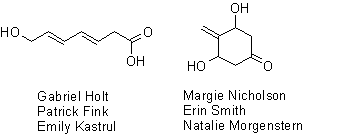
And since you are probably dying to know what the best-studied isomers look like,
Unfortunately, neither team could come up with an isomer that had been described in the scientific literature so we don't really have a "winner" in the usual sense this week. However, in the event of a tie, the judges (me) have decided that the runner-ups will split the usual prizes, so everyone will go home with half of a milk chocolate truffle pig. Enjoy. Here are the structures that were submitted this week:

And since you are probably dying to know what the best-studied isomers look like,
Continue reading C7 H10 O3 contest - Week #3 Results.
I have hired two knowledgeable senior Chem majors to help me look at your homework assignments. This means you may occasionally see notations from different pens and different kinds of assessment language. If you ever have questions about how your assignment has been marked, please come see me!
Some new codes have been introduced to help grade this assignment:
- WM - wrong model compound
- pH - wrong pH
- Rg - no pH range or wrong pH range
Please obtain a plastic model kit from the Chemistry stockroom (or a friend or whatever). They cost only $15 and if you use it (either on an exam or a homework assignment or just to clarify your thinking), you'll be glad you did.
Please bring your model kit to conference tomorrow. This will be our only chance prior to the exam to figure out together how to use the bloody thing.
Maybe this should be titled, "where not to turn in your work"?
Please don't leave homework or lab reports or lab notebooks on the floor outside my office. Don't even prop these items up against the door. I return student work by placing it on the floor outside my office so I assume everything on the floor has already been graded.
If you need to turn in something, the very best place to leave it is in my mailbox next to the photocopier and Kathy Kennedy's office (Rm. 303). If you forget and walk up to my office by mistake, you can hand me the item (if I'm there) or if the item is lightweight, you can leave it in the plastic box next to my door.
Please don't leave homework or lab reports or lab notebooks on the floor outside my office. Don't even prop these items up against the door. I return student work by placing it on the floor outside my office so I assume everything on the floor has already been graded.
If you need to turn in something, the very best place to leave it is in my mailbox next to the photocopier and Kathy Kennedy's office (Rm. 303). If you forget and walk up to my office by mistake, you can hand me the item (if I'm there) or if the item is lightweight, you can leave it in the plastic box next to my door.
-- but please don't leave it on the floor --
#1. Tomorrow nite's lab lecture (Sept 25) has been canceled. The lab work for next week will be a molecular modeling exercise, so please come to Rm 203 (computer lab) at 1 PM instead of going to Rm 209. The modeling exercise is being re-written and will be ready on Monday so do not download the exercise that is currently online.
And looking ahead to the following week ...
#2. The following week's lab lecture (Oct 2) will have to be abbreviated in order to make time for an exam Q&A session the same night (the exam is the next morning). My plan is to answer exam-related questions from 6:40-7:30. I will say a few things about preparing for the lab, but won't go into long explanations or descriptions. This means that we will have a longer-than-normal pre-lab discussion in each lab session the following week. Please be prompt.
And looking ahead to the following week ...
#2. The following week's lab lecture (Oct 2) will have to be abbreviated in order to make time for an exam Q&A session the same night (the exam is the next morning). My plan is to answer exam-related questions from 6:40-7:30. I will say a few things about preparing for the lab, but won't go into long explanations or descriptions. This means that we will have a longer-than-normal pre-lab discussion in each lab session the following week. Please be prompt.
There has been some confusion (not much thankfully, but some) over the due date for Experiment #2. Since this is a two-week experiment, your report is not due this week. Instead, it is due next week by 5 PM the day after your lab day.
I have not finished making revisions to the lab instructions, especially the parts pertaining to molecular modeling (week #2) or the report (also week #2), so please do not jump the gun on these parts of the experiment.
FYI - The Monday lab was able to complete work today by 4 PM and some students were able to finish up even earlier (two teams share each spectrometer so this allows some students to leave earlier).
I have not finished making revisions to the lab instructions, especially the parts pertaining to molecular modeling (week #2) or the report (also week #2), so please do not jump the gun on these parts of the experiment.
FYI - The Monday lab was able to complete work today by 4 PM and some students were able to finish up even earlier (two teams share each spectrometer so this allows some students to leave earlier).
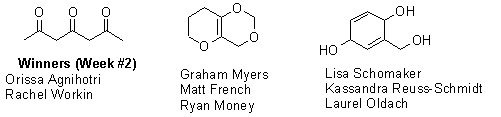
The C7 H10 O3 contest continues with three new entries. The winning team nearly hit the jackpot: 140 references. Congratulations Orissa and Rachel !!
The other teams submitted molecules that looked pretty interesting to me, but I guess organic chemists haven't had a chance to study them yet. No hits.

The contest continues with the same rules for one more week:
The other teams submitted molecules that looked pretty interesting to me, but I guess organic chemists haven't had a chance to study them yet. No hits.

The contest continues with the same rules for one more week:
The rules for entering the contest this FINAL week: any 3-5 people in the class may combine on an entry and turn it in to me by lab lecture next Th (Sept 25). Just draw an isomer of C7 H10 O3 on a piece of paper, add your names, and you're in! There are two constraints: winners from weeks #1 and #2 should not re-enter (give others a chance!) and I won't accept multiple entries from the same person.
I have rewritten two questions, #3 and #4A, on the pre-lab activity sheet for next week's experiment. If you have already downloaded the sheet and performed the necessary calculations, don't fret - the wording doesn't change any of the answers. It is simply designed to clarify what I'm looking for.
Several years ago I came across a Chem 201 exam with the following written in the margin: "Albert is sick and in pain, so I brought clean forks". Afterward I asked the student what that was all about and she re-wrote it for me:
This little ditty helped her remember which elements were found in the same column of the periodic table. Pretty clever. Do you have a chemistry mnemonic or tip to share? You can submit your tip as a comment.
AlBert is SiCk and in PaiN, SO I Brought Clean Forks
This little ditty helped her remember which elements were found in the same column of the periodic table. Pretty clever. Do you have a chemistry mnemonic or tip to share? You can submit your tip as a comment.
We won't be using liquid mercury in the o chem lab, but it was widely used in many of the research labs where I worked. I even played with some liquid mercury when I was little. This video shows you the vapors produced by even tiny amounts of liquid mercury. Check it out.
Mercury Vapor Experiment - Bowling Green State University
Problem #1 was worded incorrectly. The problem sheet handed out stated, "no stereoisomerism is possible for the top compound, but it is possible for the bottom one." The compounds should have been reversed. Stereoisomerism is possible for the top, but not for the bottom.
A closer look at the IR spectrum is revealing. The arrows point to the bands created by C=C stretching vibrations in the two alkenes.
Continue reading Conference #3 - Error in problem #1.
I have posted all of today's slides regarding infrared (IR) spectroscopy as a PDF file.If you would like to see Arthur's "H2O dance", you can find him in Rm. 410. I'm sure he will be happy to oblige.
Lecture slides
It took about 5 hours to grade all of the homework assignments (which works out to roughly 5 minutes per assignment). This was accomplished partly by using abbreviations of various sorts to simplify writing comments. If you see triangles containing 2 and 3 letter combinations on your assignment, you can decode their meaning as follows:
- CA - see (online) answers
- FC - formal charge is either missing or incorrect
- HYP - hypervalent atom (too many valence electrons)
- INC - incomplete answer
- LP - lone pairs missing (or maybe too many)
- OCT - atom lacks octet (too few valence electrons)
- SC - separated charges (either a warning to avoid these or a warning that these are missing)
- TMI - too many answers (you provided more answers than fits the question, contradictions possible)
- WS - wrong structure used for formula (note: I provided names for most of the compounds in this assignment -- cyanamide, acetone, dimethylsulfoxide -- so that you would not have to rely entirely on condensed formulas)
Week #1? Yes, that's right. Last week's contest brought in only three entries and the results were so intriguing (see below) that I thought it would be fun to extend the contest two more weeks. So I will collect entries this coming week and name a new winner, and then I will repeat the entire process the following week. So you have three chances to win in all.
The rules for entering the contest this week are identical to those from last week. Any 3-5 people in the class may combine on an entry and turn it in to me by lab lecture next Th (Sept 18). Just draw an isomer of C7 H10 O3 on a piece of paper, add your names, and you're in! There are two constraints: winners from this week should not re-enter (give others a chance!) and I won't accept multiple entries from the same person.OK. So what did this week's entries look like and who won?
Continue reading C7 H10 O3 contest - Week #1 Results.
Some of the problems on HW #2 refer to images that might not print all that well (I had to squeeze them down to get them on a single piece of paper). If you would like to see full-size full-color images then open the following files.
Potential maps
IR spectra
Potential maps
IR spectra
I have posted all of today's slides regarding potential maps, functional groups, and intermolecular forces as a PDF file. Looking over the slides, I see only 4 that I didn't get to, so I think I will just print some comments on them here and continue with new material on Monday.
Notes on last four slides:
Lecture slides (complete)
Continue reading Potential Maps and Intermolecular Forces.
If you would like to look at the pictures of localized molecular orbitals (impress your parents! amaze your friends!) that I displayed in yesterday's lecture, download the following PDF files.
Propene, CH3-CH=CH2
Formaldehyde, CH2=O
Propene, CH3-CH=CH2
Formaldehyde, CH2=O
I was going to spend a few minutes talking about isomers today, but troubles with a sluggish laptop used up my time. The material is quite straightforward so I will present it here rather than in class.
Continue reading Isomers or Resonance Structures?.
This has nothing to do with o chem, but watching 5000+ small birds fly into a tall chimney is one of the most fascinating and FREE displays of urban wildlife you will ever see and it coincides with the start of the school year. I try to catch it at least a few times every year and I will be there tonite. The rest of this comes from the Audobon Society of Portland's web page:
SWIFT WATCH 2008
Join us on the lawn each evening in September at Chapman School (on NW 25th Ave between NW Pettygrove and NW Raleigh) for the spectacular display of Vaux Swifts gathering to roost in the school's chimney. Portland Audubon volunteers will be present each night with information about the swifts, binoculars and a spotting scope for viewing. More info
An interesting question was put to me at the end of lecture today regarding resonance structures. I don't recall how it was worded, but it roughly came down to this, "Why are we drawing resonance structures?" And, I think implicit in this was a second question, "How did I choose resonance structures A, B, and C for HC(O)NH2?"
Note
- A. O=C--N
- B. (O-)--(C+)--N
- C. (O-)--C=(N+)
Continue reading Resonance structures - why? how?.
This question came up after lecture and its one worth bringing to the o chem public: Should sulfuric acid be drawn with double bonds (the way I originally drew it in lecture) or with single bonds+formal charges (the way I subsequently drew it)?
There is more here than meets the eye.
Continue reading Hyperventilating about hypervalent atoms.
Recent Comments