Reed Canyon Wildlife

With the restoration of Reed Canyon, we've been accumulating a lot of native critters. Here's a selection of some recent sightings:

Otters are making increasingly regular appearances in the Canyon - look for them early morning, particularly by the outdoor amphitheatre. 

A video of the same otter frolicking away can be seen here:

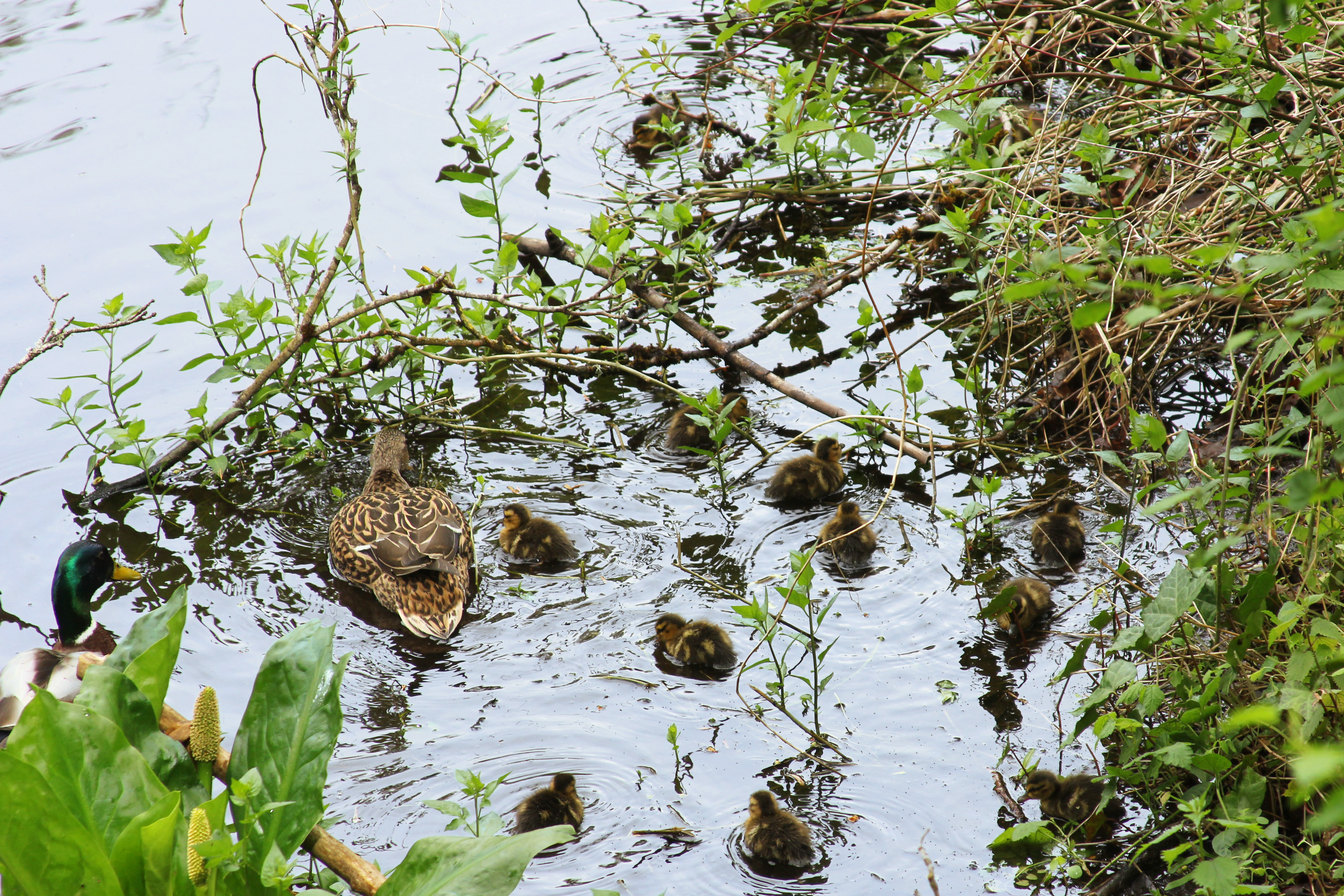
Baby ducks are also making an appearance:


A hummingbird preparing to perch:

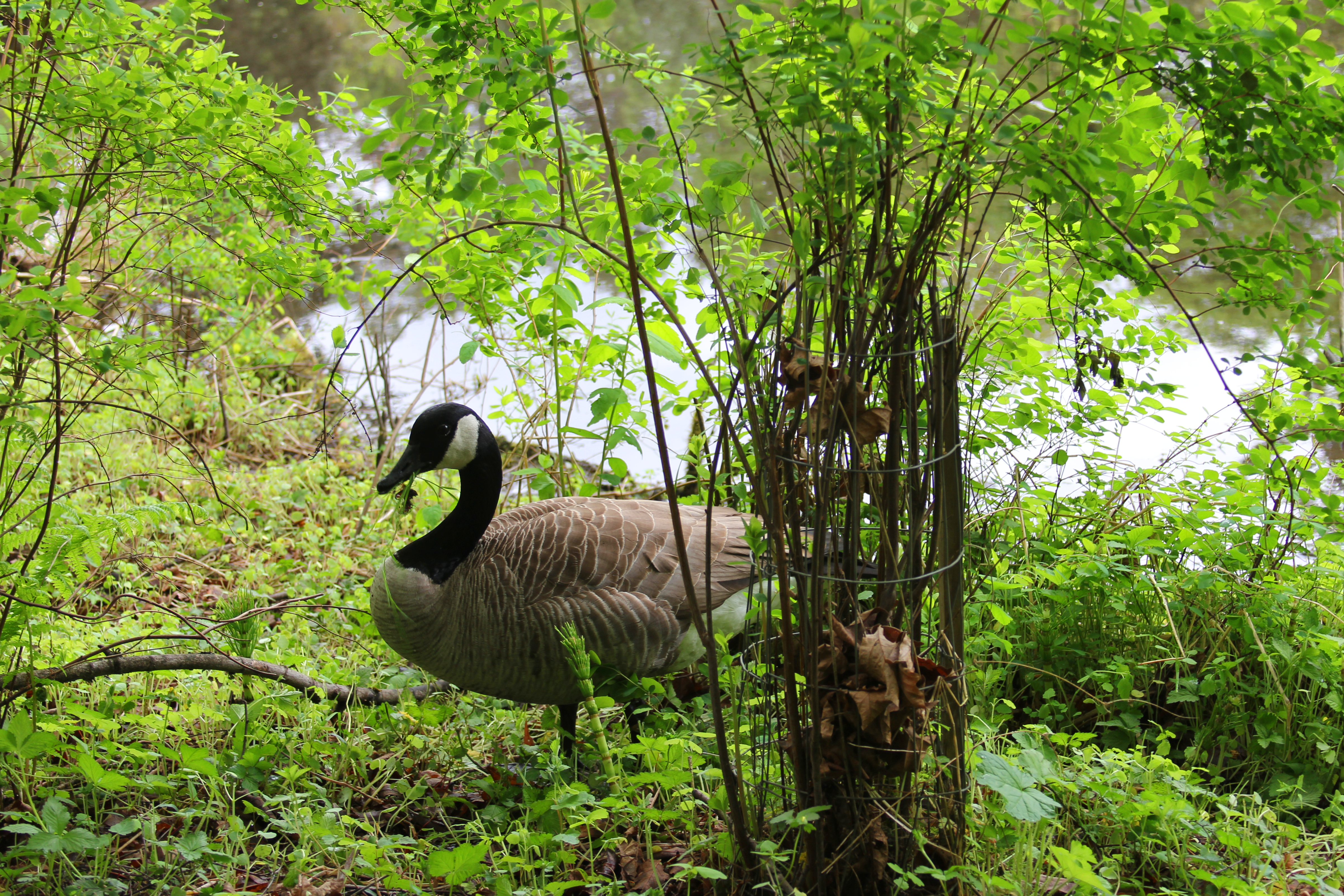
Canadian Geese make a particular fuss in the early morning. Most will simply pass through the Canyon on the way to other climes, though some will stay here and nest:

A Western Painted Turtle lounging on a log. Don't confuse it with its invasive doppleganger, the red-eared slider.

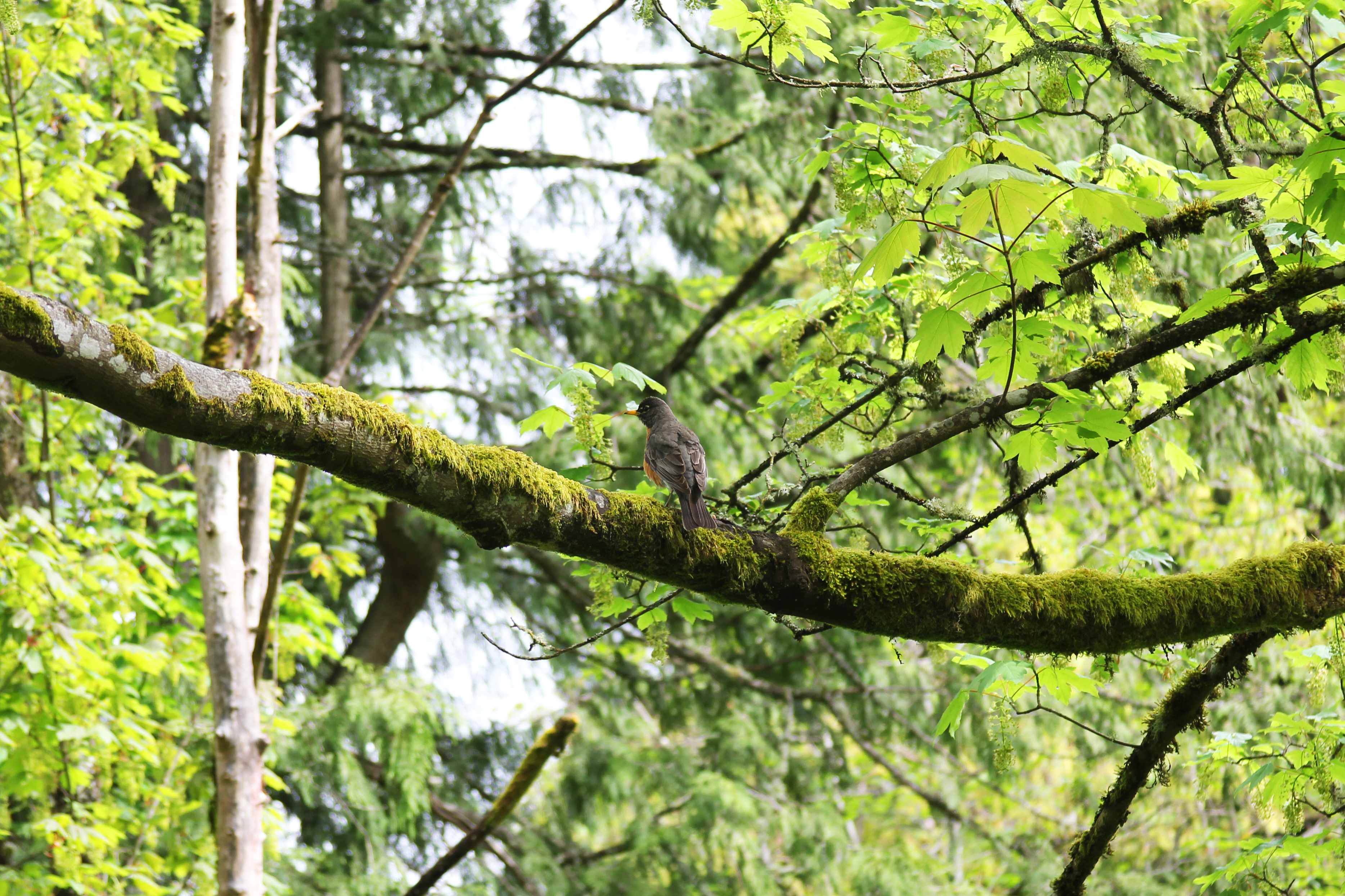
There are many beautiful songbirds in the Canyon peeping out from unexpected niches, such as this wren on a recently fallen cedar.

Interested in other denizens of the Canyon? Check out these previous entries on minks, newts and beavers, or write one up yourself! Questions, comments, concerns? Check out our Facebook page or email Zac Perry at perryz AT reed DOT edu.

Canyon Day Recap

So, another Canyon Day has come and gone - but not without leaving a pretty big impact on the Canyon. Here's a recap of what we did:

This spring, we decided to focus our efforts in the area just south of the Grove ("New") Dorms, in a bit of property sandwiched between the path to the RCAs, the Farm, and the stream. While small in area, there were many invasives, particularly the tedious-to-remove English Ivy, and few native plants to take their place. Additionally, the trails had fallen into disrepair with the winter rains turning them into mud troughs. Due to the cold and rainy weather, many of us opted for some steaming hot coffee and bagels to start our day off while Zac explained some basics:

Our first major task of the day was to repair the trails enough that they would be able to take the high traffic that would come with Canyon Day. First, we had to clear out the mud in the stairs to revert the path to its original grade:

Then, we had to bring in heaps of gravel (for the sloshiest of areas) and barkchips (for the rest of the paths) to resurface the trails:

Once this task was accomplished, we could turn our focus to the biggest task of the day - removing the English Ivy. Going at it as a front seemed to be the favored strategy:

After we pulled the Ivy, we also had to truck it out lest it reroot in the Canyon. Wheelbarrows returning from dropping off loads of barkchips were used to remove them:

Some people just worked by hand, though:

...or by stick:

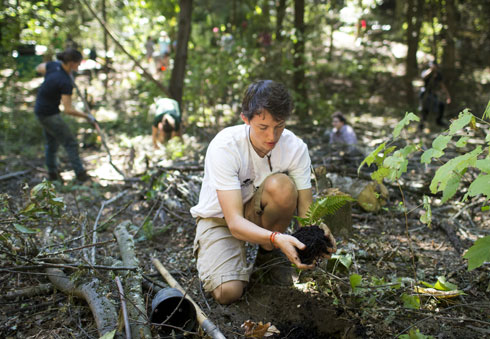
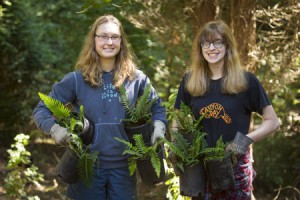
After we had enough English Ivy removed from any given location, we could then begin moving in native plants to replace them:

During all this, we had a constant supply of food, provided by a number of student organizations - the Ladies Pie Society, Cookies For All, CAVE (Carniverous Alternatives to Vegetarian Eating), and more. Greenboard also created a selection of excellent Canyon Day tshirts for volunteers:

The Dapper Cadavers provided some wonderful background music for workers as well:

At Canyon Day, we had a huge variety of people come and volunteer, including but not limited to staff, seniors, students and the very very small:

Not everyone was working all the time, though - sometimes people just needed a break:

[looking for salmon]

...and sometimes, we just needed a newt:

So - what did all this accomplish? Here's some before and after pictures. The full repercussions of having removed the English Ivy won't be felt for another few years after the natives we have planted have grown in, but it already looks a lot better. Thank you everyone for volunteering your time!


Questions, comments, concerns? Either leave a comment here or on our Facebook page, or email Zac at zperry AT reed DOT edu. 

Spring Canyon Day 2012

Hey all!

So, it's a fresh spring and Canyon Day is officially here. We have a lot on our laundry list for this time around, so we could really appreciate your help. 

This year we will be focusing our efforts in the area below the Grove Dorms and above the Farm. For those unfamiliar with Reed's layout:

A lot of what plagues this place is the usual answer - invasive species. Here, the cocktail consists primarily of English ivy, forming a thick, suffocating carpet across the ground and Himalayan blackberry, choking out whatever manages to break through. Removing these, while perhaps tedious with a crew of only three or four, should go much quickly when we're at it flash mob style.

Of course, removing the invasives doesn't do us a whole lot of good if there's no alternative. So, we'll also be asking for help planting a veritable army of native species - sword ferns, Oregon grape, and other perennial favorites. By first removing the invasives, we should be giving them enough of a head start to pull through, as we have seen in other successfully restored portions of the Canyon.

As many people have been noting recently, the trails through this area - favorites of those making their way to the Theater Building - have been deteriorating under pressure from the combined force of spring showers and increased traffic. We're hoping to get a few convoys of bark chips and gravel into trouble spots to patch them muddy spots and make them navigable once more to those not decked out in hiking boots. 

To feed the hungry masses, we'll be providing our usual fair - coffee and tea for those who crave caffeine, Ottos sausages for the meat lovers, and a selection of catered bagels, jams and cream cheese for the rest of us. We'll also have entertainment to keep your ears occupied while your hands toil away, brought to you by the Dapper Cadavers, a bluegrass band featuring Reed alums. You can also just take a break by walking through the Canyon - it is particularly beautiful this time of year as native plums, skunk cabbage and other plants are in full bloom and other plants begin to send up vibrant green sprouts:

Interested? Check out our Facebook event page, or look for the signs posted at different trail entrances to the Canyon. It runs 9-3PM this Saturday.


Let's Occupy the canyon!

springcanyonday12flier.tif

Two weeks until the kick-off of spring in the Reed Canyon!


We are hoping you can make it to the spring Canyon Day event on March 31st. We will be in the lower canyon near the creek and behind the Canyon house.


If you're not sure where that is- follow the signs from the running tack westward and listen for the sounds of celebration.

The closest parking lot is off 28th Ave- next to '28 West'-security building.


We will be focusing on removing the infamous English Ivy from the hillside and freeing the native shrubs- of its grasp-

And where appropriate- introducing native trees and shrubs.


This event is fun for all ages- come early and plant your own native wildflowers from seed- to take home!


Help spread the word- introduce someone you care about to the wonders of the canyon..


More information; www.reed.edu/canyon


See you there

A Kinda Sorta Spring

It's been pretty difficult at times to tell whether it's actually spring or not lately - one day Reedies will be frolicking on the lawn in all their newly sunburnt glory, the next a stern frost and some slushy snow will be giving us reaching for our mittens on the way to morning classes. Mixed messages abound. However, flowers have been blossoming at a steady rate, and it seems like maybe - this time - the sun and thaw might stick for a while. Here's a selection of springtime pictures from around the Canyon - art projects, nature and all. Feel free to submit your own either on our Facebook page or writing up your own blog entry!

IMG_3164 emerge.JPG

IMG_3221 pale spring.JPG

IMG_3193 nest.JPG

IMG_2625 peace.JPG

IMG_2657 cold spring.JPG

IMG_2483 green stuff.JPG

Things that go Bump in the night

Spring brings many changes in the canyon- longer days, the smell of the skunk cabbage in the headwaters, the sounds of birds frolicking in the upper branches of the canopy. But most recently we see this change in seasons welcome a familiar guest the river otter (Lontra Canadensis).


otter1.jpg

Although observed in the canyon before- this most recent visit is much earlier than noted in previous wildlife monitoring. Also for the first time since the restoration began in 1999 we've seen a 'family' of otters.


So the obvious questions seem to be- did our river otter make new friends? Does she live year round in Reed Canyon? And what does she eat?


Last week it was noted that there were three otters frolicking west of the blue bridge near the fish ladder. The lake was calm that day other than the ripples as a result of their playful habits stirring up the lake bottom in their consumption of crustaceans. As I approached closer for a better look I noticed that they were freely swimming in and out of an old beaver den located on the north-bank below the cross canyon dorms- at which point I was spotted- the alarm went off - and one of the otters started to bark and kept a close eye on my actions while the other two darted on the lake bottom under the tree I was standing closest to. Otters are known to be active year round in our waterway, and the seasonal visits by this critter are thought to be more about food shortages downstream and changes in environmental conditions.


otter3.jpg

So why Reed Canyon? And why now?


River otters seem to prefer permanent watersheds with constant flow. They favor bog lakes with banked shores. Interesting enough otters compete with the American mink for resources (this is the first year we've seen mink in Reed Canyon) http://blogs.reed.edu/reed_canyon/2011/11/mink-of-the-week.html.

Otters have few natural predators, but their terrestrial predators do include coyotes. Otters have the ability to easily travel 5 miles in a day. So with that in mind, these otters could have been swimming in the Willamette River the same day they were spotted in the canyon. They probably used the fish ladder to gain access to the upper section of Reed Canyon and the lake area.

Not necessarily nocturnal- these fuzzy critters do seem to be most noticeable during the early morning hours and all but gone by 10am

You can see signs of their nightly feasts by cruising the North-edge of the lake and looking for the remnants of the fresh water mussels.


DSCF1098.JPG

A family of otters generally consists of an adult female and her progeny. Adult males also establish social groups with other males. Male otters do not seem to be territorial, and allow other dispersing males to join their group.

Groups occur most often in autumn and winter. From mid-winter until the breeding season, female otters move and den alone. River otters breed from December until April. Female river otters do not dig their own dens; they rely on the dens of other mammals, such as beavers.

Litter sizes range from one to three pups. The mothers raise their young without aid from adult males, and she introduces the pups to water when they are about two months old. Pups leave the den at eight weeks, and by fall are capable of sustaining themselves. Before the arrival of the next litter, otter yearlings venture out in search of their home ranges.


These otters may have affects on our resident fish populations and our amphibian migrations. This subject now offers itself to our local scientists and provides opportunities for field research to compare prior populations to current populations and begin to unfold the complex eco-system of our beautiful canyon. After all, the presence of otter in our lake and nearby stream indicates a healthy environment, as they are near the top of the food chain in aquatic systems.

Just a few winter logistical notes for this week's blog entry:

This time of year, where the proportion of rain-to-sun gets to SAD levels, we also find the trails in the Canyon getting a little muddy at times. Some people will take it on themselves to insert large sticks into the trails to give their feet a bit more purchase when they have to get through wet patches:

don't do this.JPG


However, this is also a bit dangerous, as the sticks get slippery in the mud which make them easy to turn an ankle on. Given how many people like to jog through the Canyon, especially in the bleary early morning light, this is a real hazard that we'd really rather not have. So, if you see a particularly bad patch of trail, please contact Canyon Crew instead of feeling obliged to take care of the issue yourself. Having to remove all the csticks first makes our eventual patch job take even longer. That being said, if you're interested in taking a more hands on approach to taking care of the Canyon, feel free to contact us to volunteer! It doesn't have to be Canyon Day to pitch in. 

.

Everyone has a different use for the Canyon. For some, the conveniently placed benches with their views of the scenery make for the perfect smoking break. While smoking in the Canyon is fine - what do you with your body is your own choice as long as you don't harm other people -some people will choose to contribute some carcinogens to the ecosystem by tossing their cigarette butts on the ground. This makes for a tedious trash clean up every morning, to seek out and remove every single dirt-covered filter we can find. So, please pack out your cigarettes with a reusable Altoids tin or something similar along with the rest of your trash. We'd rather not have to start up a trash service in the Canyon, which could be a magnet for wildlife that will suddenly not be quite as wild if they start picking through dedicated trash receptacles and also be a serious time sap on the part of Canyon Crew. If you see someone littering in the Canyon - speak up! 

IMG_2020 butts.JPG
 
this is not how you play checkers guys.JPG

.

Reed College is kind of a weird place, so it makes sense that our trash reflects this. Last week, our round up of weird things we found in the Canyon included, amongst other things, a fine leather adventuring hat in the middle of the stream, a prosthetic ear and... a key and a keyhole in the hollow of a tree.

 keys and keyhole.JPG

While entertaining, we'd like to encourage you not to intentionally leave such items in the Canyon, as the materials can be hazardous to the wildlife and also detract from the 'wildness' of the place for others.

.

Questions, comments, concerns? Want to see something in particular up on the Canyon blog? Contact us via our Facebook group or Zac Perry at perryz AT reed DOT edu.


The Canyon in Winter

Winter in Portland is always a rather amorphous, vague season, one that sometimes feels more like a transition between fall and spring than anything unique in and of itself. The color palette, perhaps, is distinct, as the gray of the rain and green of the moss and evergreens are left isolated:

IMG_0024 green tree.JPG

It's also a good time of year to notice the little details, ones that may have been obscured with leaves previously:

IMG_0545 droplets.JPG

IMG_0051 drops on gray.JPG

IMG_0542 stump.JPG

However, that's not to say that the Canyon is lacking all of these other colors - given the rare sunny day the place lights right up.

IMG_1991 morning color.JPG

Winter doesn't really mean lifeless; there is plenty of fauna frolicking about that is much easier to see without all the foliage.

IMG_0015 squirrel.JPG

But we've also got hints of the incoming spring - skunk cabbage sprouting through leaves rotting from last fall, for example:

IMG_2014 skunk cabbage.JPG


So - enjoy winter while it lasts, whatever it consists of. :-) Spring posts, if the proliferation of green things sprouting underfoot are any indication, are likely forthcoming.

.

All photographs taken by the author of this article.

I've got newts on the brain!

Every so often, a Reed biology senior is lured into the Canyon for an ecology thesis. Perhaps it is the desire to discover some secret Reed knowledge, or the appealing shimmer of stickleback fish in a minnow trap. Perhaps it is the convenient location. For me, it is the need to know where the frogs, salamanders, and snakes make their homes, how they get along, and how they feel about the restoration efforts. Reed Biology showed me the fascination of herpetology, community and restoration ecology. And after being told by many seniors last year to "study something you like -- you have to do it for a year!", I knew the Canyon would make an excellent laboratory playground.

Welcome to Beaver Country

Beaver's are as busy as ever out here in the canyon. As the temperature drops- and the nights are long we find ourselves in the prime of beaver season. Historicly at this time of the year there is a lot more obvious chewing at the base of the surrounding canopy. It is suspected that at this time of year we are dealing with hungry pregnant beavers. Filling up on cambium before their babies are born. Young beaver have been observed in Reed Canyon as early as March swimming near the edge of the canyon looking for young saplings and aquatic plants to munch on.

Unlike most other rodents, beaver pairs are monogamous, and stay with their partner for multiple breading seasons.

American Beaver (Castor Canadensis) is considered the largest rodent in North America and the third largest rodent in the world behind the capybara, and the Eurasian beaver. In Reed Canyon it's not uncommon to see mature beaver weighing over 50lbs. and at a length or 3 feet.

beaver picture.jpg

These semi-aquatic critters are mostly active at night. If you wanted to come to campus and see one of these guys for yourself I would recommend positioning yourself near the amphitheater on the south-side of the trail system right before dusk- I usually hear a big splash around that time- which is the beaver leaving its den and slapping the water with its tail (the den is right below your feet right now- and as you walk eastward towards the bridge- you'll probably walk over 4 more.) If you follow them form here- you can observe their feeding habits as they make their way eastward towards the springs and the shallows of the canyon to feed and gather woody materials for dam-building.

Another good vantage point to observe beavers in the early evening is from the perspective on top the blue-bridge. From here you can see them swimming on the lake's bottom to the east as mentioned before.

In the canyon you won't see beaver lodges - since our system is spring fed the lake doesn't freeze solid and mobility and access even in the coldest of years is never much of an issue. What is more typical in our system is the observation of dens- along the edge of the lake, generally under the shoreline trees. The Reed-beaver use the roots of the trees as the roof of their den-which works fine for the most part until the beavers undermine the trees to a point in which they fall into the water. So next time you take a look at the middle and lower lake areas- look at where the trees have fallen from- if you get close you can still see the signs and size of these areas the beavers call home.

DSCF1082.JPG


Managing a restoration of an urban greenspace that has beaver one must learn to love and appreciate the beaver and all it does. Fortunately the beavers seem less interested in the newly introduced cuttings I've been putting around the lake's edge- but just as I get comfortable with that- in one evening the beavers can wipe out a grouping of 10-year-old tress. So I have been forced to wrap cages around the trees that are most sensitive to beaver predation. But I also understanding that most riparian shrubs actually benefit form the grazing practices of the beaver- specifically willows, dogwoods, and spireas. The grazing forces these plants to send out multiple tops from several growing points which actually helps shade a larger area of stream-bank, and the repeated grazing helps stabilize the stream banks by forcing the root structures to spread-

This natural thinning also allows for more light penetration to the canyon floor giving secondary plants opportunities to move up in sequence and become dominate.

DSCF1077.JPG

The woody materials that the beaver collect seem to mostly be used to construct a system of dams at the eastern part of the canyon- these dams can affect the hydrology of the system-but that's not necessarily bad. These pools actually allow for fish, waterfowl, and amphibians to access and reside in areas that were less suitable prior to the creation of the backflow. The creation of standing water in some of the upper wetlands has actually helped me control some of the invasive grasses- that were aggressively infilling the springs area- by having the standing water over the grasses, the geese and ducks have moved in- grazing the grasses to their roots and limiting their ability to reproduce by seed or rhizome.


So as you may feel the affects of these short days and wonder what to do with yourself in-between rain storms come take a walk though the canyon- right now is a great opportunity for all ages to touch and see the nightly chewing of our state animal. Reed lake is considered the oldest naturally occurring lake within the City of Portland- without beavers these spring waters would have never had the opportunity to provide habitat for such a wide-range of indigenous species. Salmon, heron, amphibians- oh my!

DSCF1072.JPG

Visit the Reed Canyon website

For more information, visit the Reed Canyon webpages.

Canyon videos

Archives