You can find a variety of things here as you prepare for next week's exam:
Month: September 2012
-
(More) Practice problems for learning activity 7
The learning objectives for activity #7 include being able to interconvert free energy changes (ΔG or ΔPE), equilibrium constants (Keq) and the percentages of the two conformers at equilibrium. Unfortunately, I neglected to list practice problems for this topic and there are three in Sorrell that you can attempt (and probably even more if you look back at your Chem 102 text):
Sorrell Ex. 3.6, 3.7, 3.14
-
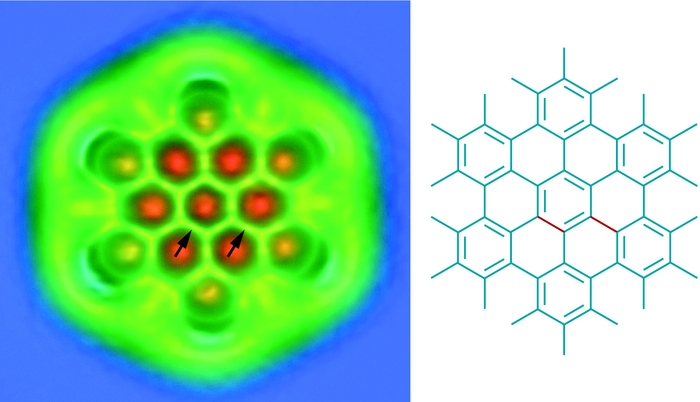
Bond Order Goes under the Microscope
The 2012 Sept 17 issue of Chemistry & Engineering News ("C&ENews" is what we call it) begins with an article, Bond Order via Microscopy. A team of scientists at IBM's Zurich research center used a scanning probe microscope to investigate electric fields in a large flat aromatic molecule. The images they generate look surprisingly like the bond pattern in the molecule. If you want to get even closer to this project, check out their research publication and microscope images in the 2012 Sept 14 issue of Science magazine.
-
Lecture slides (Day 5) for hybrid & molecular orbitals
You can download the slides that I showed last Wed/Thur (Sept 12/13) here.
I didn't get to show all of the slides, but if I could have, I would have divided the talk into three sections:
- what you already know (from Chem 101)
- the creation of MOs by combining AOs (or HOs) and the importance of overlap
- examples of MOs
There are some really beautiful photos of bonding MOs, and even a few antibonding MOs, in the third section. Please look them over carefully. Make sure you can say the following about each MO:
- is it bonding or antibonding
- is it sigma or pi
- what atoms are involved
- what atomic (or hybrid) orbitals are involved
-
Learning objectives (Day 5) for hybrid & molecular orbitals
I have prepared a list of learning objectives and study tips for last Wed/Thur's (Sept 12/13) class. You can download them here.
-
Challenge Problems + Molecular Modeling Questions = Answers
I promised that I would post answers to the challenge problems in the learning activities and I have also received requests for 'answers' to the molecular modeling activity (#2). Here are some answers and comments.
Keep in mind: many of the questions in the learning activities are designed to help you build concepts. They are not "problems" in the usual sense and they don't reflect the kinds of problems that might appear on exams. Your book's end-of-chapter problems offer a much better idea of what you can expect exam-wise.
Learning Activity #3 – Answers to Selected Questions & Challenge Problems
Learning Activity #4 – Answers to Selected Questions & Challenge Problems
-
Beyond Oil and Water
Organic chemistry is filled with mysteries. The measurements involved in this week's experiment (solubility of alcohols in water) are straightforward, but scientific understanding has not really kept pace. Why do some liquids mix and others separate into distinct phases (that are usually mixtures) is still a mystery with cutting-edge applications.
A perspective article in the 31 Aug 2012 issue of Science magazine (DOI: 10.1126/science.1223728) wonders whether "the organization of cellular compartments may be driven by liquid phase separations". Cell biology meets organic chemistry.
-
Vaux Swift Watch 2012
 This post has nothing to do with o chem, but I think watching 5000+ small Vaux swifts swarm and then roost in the Chapman School chimney is one of the best FREE displays of urban wildlife you will ever see. Fortunately, the timing and location are perfect for Reed students. Head towards the Chapman Elementary school in NW Portland (#15 Bus will get you very close) on any night in early-mid September. Arrive about 30-60 minutes before sunset (7:00-7:30 arrival during Labor Day weekend) if you just want to see birds. Or, bring a picnic and a ball if you want to hang out in the park next to the school before the birds put on their show. The warm late-summer evenings are perfect for an outdoors off-campus adventure.
This event is not to be missed
Some helpful info for swift viewing:
Directions: The chimney is located at the west end (hilly side) of Chapman Elementary school. The school is located next to a park on NW 25th between NW Pettygrove & NW Raleigh. After you see the swifts, you can walk over to NW 23rd for dessert – many many establishments will be happy to serve you between 8-10 PM. Map
Best viewing: Get there about 20 minutes before sunset and watch the birds collect and feed. It takes awhile for all of them to go into the chimney so you'll be there after sunset (full moon tonite). Most people watch from the hillside on NW Pettygrove, but be kind to the neighbors.
Portland Audobon web info