Month: November 2008

  • Huckel's rule, aromatic character, and molecular orbitals

    Today’s lecture tried to tie Huckel’s rule to a number of topics, including:

    • aromatic character, a more nuanced way of talking about aromaticity
    • charge distributions and geometry
    • evaluation of “minor” resonance structures
    • molecular orbital theory

    You can see all of the slides that were used here. I also remarked on the connection between various sources of polycyclic aromatic hydrocarbons (especially benzopyrene) and various sources of cancer. Here are some links that I found interesting:

    • benzopyrene – nice summary of chemical and biological phenomena including cancer discussion
    • In a Puff of Smoke – a site created by the Chemical Heritage Foundation for teachers (at what level? high school maybe?) that explores the science behind tobacco and other causes of cancer. Some facts that I discovered: U.S. per capita consumption of cigarettes rose from 94 per year in 1910 to 2,558 per year in 1940 (that’s per capita and since some people don’t smoke at all, consumption by smokers was actually much higher). Actually, there’s plenty of information here that I didn’t know.
    • Percivall Pott – the doctor who was the first to suggest a link between chimney soot and cancer
  • Supersized ferrocene impossible?

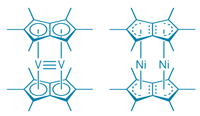
    Ferrocene and acetylferrocene, the compounds featured in our current lab experiment, are examples of sandwich compounds or metallocenes. A metallocene of some sort has been made with every transition metal in existence, but double metallocenes in which two organic rings are fused together (see figure) have proved more elusive. The first ones were made in the 1970s, but chemists couldn’t figure out how to fit very many metals into the double metallocene structure.

    A recent article in the Journal of the American Chemical Society (J. Am. Chem. Soc., 2008, 130 (46), pp 15662-15677, web publication Oct 22, 2008) describes how chemists have solved these problems to make double metallocenes of V, Cr, Mn, Co, and Ni. Some of these complexes (V, Mn) seem to contain direct metal-metal bonds, while others (Cr, Co, Ni) do not.

    double metallocenes 8644scon_1.gif

    C&E News, Nov 3, 2008, p. 22

    Curiously, all attempts to make a double ferrocene were unsuccessful, so while ferrocene occupies a privileged place as the first metallocene to be made, double ferrocene may prove to be an impossible target. But who knows? Chemists love a challenge.

  • Alkene pi orbital energies

    A question on today’s conference problem set asked you to predict how the energies of the pi and pi* orbitals of a typical alkene would respond to twisting the alkene.

    Valence bond fans: The VB model doesn’t contain “pi” or “pi*” orbitals, but it correctly predicts that twisting the alkene destroys p-p overlap, i.e., destroys the pi bond and destabilizes the molecule.

    The following picture shows the answer to the conference problem (click for larger image). The planar alkene is shown on the left and the fully twisted alkene on the right. The pi MO (bottom) and pi* MO (top) energies of the planar alkene are very different (vertical axis is MO energy). As we twist the alkene, the two MO energies converge.

    L27.111308 answer to conf 11 MO diagram.jpg

    To make this prediction you need to visualize each MO as being constructed from two 2p orbitals. If the overlap between these 2p “pieces” is “bonding” (no node + orbitals close together), as in the pi MO, it stabilizes the MO. Twisting reduces the overlap and destabilizes the pi MO. When the overlap disappears completely, the pi MO energy becomes equal to that of a 2p orbital.

    The opposite behavior is seen when overlap between the 2p orbitals is “ANTIbonding” (node + orbitals close together). This kind of overlap destabilizes the MO and that’s why the pi* MO is higher in energy. Twisting the alkene stabilizes the pi* MO because the antibonding overlap is reduced. When the antibonding overlap disappears completely, the pi* MO energy equals that of the pi MO.

  • Models of Chemical Bonding

    Today I decided to re-trace my steps on Monday and provide a more complete description of chemical bonds through the eyes of molecular orbital theory. A list of take-home lessons from this presentation:

    • MO models contain new orbitals (molecular orbitals), while VB (valence bond) models do not
    • MOs can be mentally (de)constructed as combinations of atomic orbitals

    So far not much new stuff … the previous points had already been made in the context of the “localized MO” model presented at the start of the semester.
    (more…)

  • Halloween Pumpkins

    Halloween fell on Friday this year so I should have been expecting a “trick” or “treat” when I arrived at lecture. Little did I know that I would get both.

    Everyone was seated in the dark when I arrived and two jack-o-lanterns were glowing on the front table. It took me a few moments to figure out that I should look at the front of them to see how they were carved. To my surprise, both had “organic” connections, glucose on the right (all equatorial chair conformer) and retinol (vitamin A) on the left.

    Retinol is a rather long molecule so it required two photos from different angles to capture the entire molecule. Alex, thanks so much.

    Left side of molecules (click for full size):
    IMG_0747 trimmed.jpg

    Right side of molecules (click for full size):
    IMG_0737 trimmed.jpg

  • Bromonium ions

    Here are pictures of the models that I shared with you in class on Monday. They address different issues.

    Model #1 – A Stable Bromonium Ion. A bromonium can be stabilized by placing large groups around the alkene. These groups offer steric hindrance to the bromide anion so that backside attack can’t occur.

    Notice that the “alkene” carbons in the reactant lose their planar geometry when bromine bonds to them. This geometry change pushes the bulky substituents downward where they block the path of any nucleophile that approaches from the backside. Since this also increases the exposure of the frontside of these carbon atoms, you might regard the stability of this ion as further evidence that SN2 reactions require backside attack.

    View image

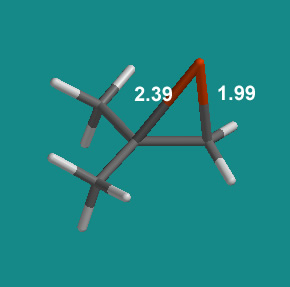
    Model #2 – Unsymmetrical alkene leads to unsymmetrical bromonium ion, plus SN1-SN2 ring-opening. An unsymmetrical alkene like Me2C=CH2 produces a geometrically distorted bromonium ion like the following:

    L23.110308 unsym bromonium ion GEO.jpgNotice that one CBr bond is much longer than the other, 2.39 v. 1.99 A. A normal CBr single bond is 1.95 A, so one bond in the bromonium ion is almost “normal” while the other is considerably weaker.

    (more…)