If you want to practice your speaking and listening skills in a foreign language, you may be interested in a language exchange with a native speaker and English learner, in addition to meeting with the drop-in and individual tutors available at Reed. During the exchange, you speak with your language partner for about half an hour in English to help them with their spoken English skills and then for half an hour in their native language to help you. Language exchanges can be especially useful if you’re studying or practicing a language not currently offered at Reed or not supported by Reed tutors (Arabic and Japanese, for instance). There are several websites that help language learners meet for a language exchange. Continue reading “Online language exchanges”
Blog News
Zombie: a video paper; a nontraditional treatment of a traditional assignment
The idea: or, how one thing leads to another
Last spring, a student named Hannah came to my office with questions about overlaying animation on video to explain movement in a visually narrative way. She wanted to analyze a video and thought that if she used animated (moving) annotations in conjunction with it she could better get her point across. The subject matter was dancers and their interaction with musicians. We looked at a few examples she liked online that utilized animation and video. We talked about the time she had available and what was feasible in regards to time needed for the technical command of the software and creating a finished product that would be useable. After talking about it we ended up using Final Cut Pro X (FCPX) to do this; a multimedia “paper” was in motion.
The paper was due in two weeks. Over that time, Hannah learned FCPX both through our meetings discussing best practices and through trial and error while doing the work. As a result, she gained enough command of the software to move beyond the basics and make some new discoveries that carried through to the final draft.
The process: start, stop, struggle, proceed, refine
I don’t think the creators of FCPX conceived of the application as a way to complete a college paper, but leave it to a Reedie to find a way to skew its intended use! Hannah’s use of FCPX was unconventional and creative, but the software supported it nicely. In addition to animated annotations, Hannah included freeze and still frames, inserted text frames, and used slow motion and split screen functionality to support her analysis of the movement phrases. After a few meetings with me, her own research, and some standard back and forth regarding new questions that arose as she explored the software, she got to work. I watched as her technical facility in the software led to new ideas and directions we didn’t even discuss.
Then came the editing. Good editing requires distance (time away) from the project; an unbiased, razor-sharp eye; and a good sense of form, pacing, and detail. Practically speaking, one has to have the ability to step back, analyze the rhythm of the transitions, tighten up timings so there is smooth flow, and make sure everything is cohesive. Usually, having another person look at the project is helpful. When immersed in nuts and bolts technical video work, it is hard to visually step back. If that is not possible, your best bet is time away. I helped by watching her video a few times and making some suggestions. We only had time for one round of revisions; ultimately, two or three would have been the most helpful. That said, the video still works very well.
The product: Zombie
Below is the final product. This was an wonderful example of Seymour Papert’s notion of computer-aided inspiration: the creative use of technology in education. (Papert, Seymour. Mindstorms: Children, Computers, and Powerful Ideas. New York: Basic Books, 1980.)
Hannah did an excellent job in the time available to her. I believe she opened the door for other students to use FCPX this way in the future and broke new ground by using video technology to communicate elements of her analysis that would have been difficult, if not impossible, to deliver in a traditional paper.
A few of my favorite (mapping) things
Fall break is here, and I expect Portland fall weather to set in any minute now. In anticipation of hunker-down-and-curl-up weather, here’s a handful of geospatial delights that might pair well with a hot mug of something and grey skies: open source geodata in action, some great work from colleagues in Seattle, and a beautiful compilation of imagery of the Oregon coast. Continue reading “A few of my favorite (mapping) things”
Creating nice tables using R Markdown
One of the neat tools available via a variety of packages in R is the creation of beautiful tables using data frames stored in R. In what follows, I’ll discuss these different options using data on departing flights from Seattle and Portland in 2014. (More information and the source code for this R package is available at https://github.com/ismayc/pnwflights14.) Continue reading “Creating nice tables using R Markdown”
Language Labs: A Brief History
The middle of the 20th century was an exciting time for foreign language study in the United States. During World War II, the army created the Army Specialized Training Program (ASTP) to provide education to officers with strategic wartime skills, including foreign language proficiency. Following the scholarly opinion among linguists of the day, who believed that language was acquired through habit, the ASTP taught language primarily through oral drills. As the ASTP spread to institutions of higher education throughout the country, the army developed audio discs in dozens of languages.
New at the PARC 2015/2016
New at the PARC 2015/2016
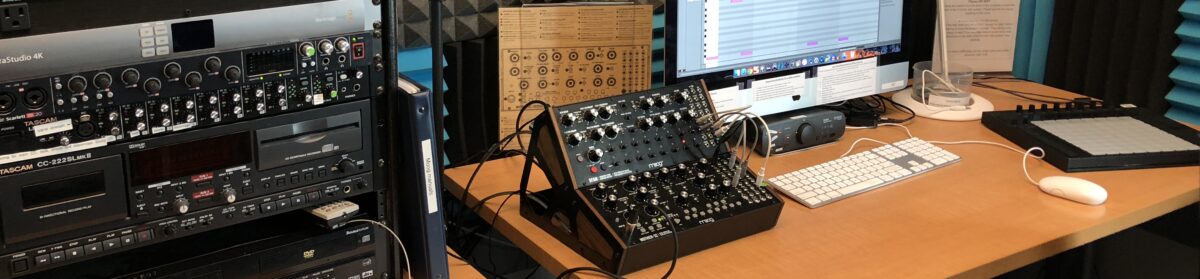
Welcome back to a new school year! It has been a busy summer at the Performing Arts Resource Center getting ready for it. I am excited to let Reed know of new hardware available for immediate checkout at the PARC.
We now have microphones! They have been chosen for their flexibility and multiple configuration possibilities. Remember, each microphone has its own character; no two mics are the same. Also, placement and process (which DAW you are using, your signal flow, and your instrument and instrumentalist quality) are huge parts of your final product. Experiment, use your ears, and have fun! Continue reading “New at the PARC 2015/2016”
729 Miles : collaborations in educational technology across the Pacific Northwest
Educational technology is by nature a collaborative effort, with faculty, students, and staff working together to build an effective learning environment within and beyond the classroom. In order to foster relationship across campuses, in May 2015, Reed and Lewis & Clark co-hosted the first collaborative instructional technology event sponsored by the Northwest Five Consortium* (NW5C). We dubbed the conference “729 Miles of Technology”, a name taken from the distance of one route connecting the five campuses. (You can view the full program and other conference details at the project website.)
Continue reading “729 Miles : collaborations in educational technology across the Pacific Northwest”
Pan to Zoom in iMovie and Final Cut Pro X
In my last post I talked about zooming into and cropping an entire video clip in iMovie and Final Cut Pro X (FCPX). Another approach to this is to use zoom as an effect to “crop” into your image while panning in your video clip, an effect if not originated at least made very famous by Ken Burns. In both iMovie and FCPX there is a function to do just this, appropriately named the Ken Burns Effect. This will let you create an animated pan (the effect of motion within a video clip) to a crop that has a smooth flow from one section of your video to another.
Continue reading “Pan to Zoom in iMovie and Final Cut Pro X”Getting on the map (workshop)
On May 29th/30th, Reed is co-hosting the inaugural instructional technology conference of the Northwest Five Consortium (NW5C). I am leading a workshop on maps, mapping, spatial analysis, and spatial thinking; materials below.
- Hands-on #1: Social Explorer (instructions) (website)
- Hands-on #2: Brief Buffering in QGIS (instructions) (download data)
- Hands-on #3: Working with Longitude/Latitude data (instructions) (data)
Additional links:
- City of Portland comprehensive planning app (raster data in action!)
- Georeferencing in QGIS (tutorial)
- Diva-GIS (free, international spatial data)
- Natural Earth (physical, political, cultural data)
- NHGIS (Census + spatial data, 1790-2013)
- openstreetmap (global, crowdsourced data)
Why should students at a small liberal arts college learn R?
From an educational philosophy perspective, learning to program is well aligned with what we strive to teach our students. Becoming proficient in statistical programming requires the ability to think critically about complex problems, to develop scientific research questions, and to apply rigorous analytical methods to answer your questions. I believe these skills are key elements to a strong liberal arts education. We want our students not only to be able to think critically about the world around them, but to have the skills to critically engage with the world. Continue reading “Why should students at a small liberal arts college learn R?”