

Many of the library’s electronic resources are incorporating machine learning-based tools. Although we are not currently pursuing the adoption of any of these tools, we do want to get some hands-on experience using and comparing them.
So, today, we are starting a 30-day trial of an AI tool for Scopus, our major abstract and citation database. The goal of this trial is to assess this new type of tool but within a resource many of you already use regularly and know well. That way we can see if it adds value to your research efforts and coursework – or not.
What does it do?
Scopus AI is essentially a search tool. It’s easiest to think of it as a powered-up version of the kinds of searches you can already do, with augmented search results. The tool covers Scopus abstracts and citations that date from 2013 to the present, which means any content older than 2013 is not included.
Where do I find it, and how do I access it?
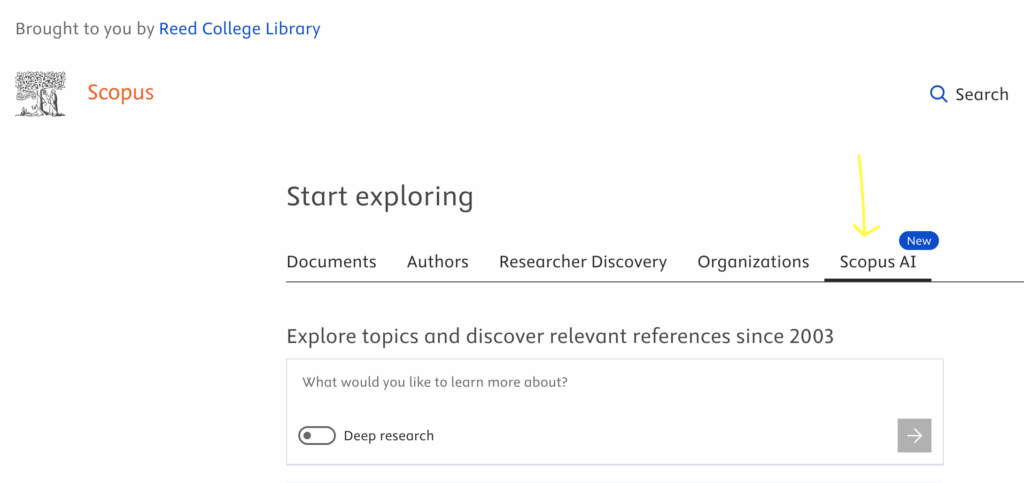
Scopus AI is a tab visible in our existing Scopus interface. Select that tab and then enter a research question in the search box. You will see a great deal of information in the results, so we recommend reviewing the Scopus AI Quick Reference Guide [PDF] for a key to all the different elements.
Who owns it?
Scopus is owned and developed by global publisher Elsevier. We subscribe to many Elsevier resources, including Scopus, various ebooks, and a large package of journals. Elsevier has licensed OpenAI’s GPT and combined it with other large language models (LLMs) and their own proprietary technology in order to create the Scopus AI tool.
What is its structure?
Scopus AI is a closed system, which means that the generative AI tool works only within the bounds of the Scopus database. If you perform a search and generate a list of citations, you may be able to reach full text for those cited resources if they are part of our other Elsevier subscriptions. (The full text will be available on a different Elsevier platform called ScienceDirect.)
Is it safe to use?
The company says that there is no data exchange with the open web and that information gathered during your use of Scopus AI is not used to train the public version of ChatGPT.
We highly recommend you review Reed IT’s Generative AI Guidelines for Security and Privacy before you try out this tool. You can also review Elsevier’s Responsible AI Principles, Privacy Principles, and Privacy Policy.
Useful Links
Elsevier Playbook: Information Literacy and Research Workflows in the Age of AI [PDF]
Our trial ends on March 16, so please test it out and, while you do, ask this fundamental question: would this support the learning, teaching, and research happening in the Reed community?
Whether you’re a student, faculty member, or staff member, we welcome your answer to this question! To share your thoughts, please complete our trial feedback form.
If you have questions about this trial, email library-er@reed.edu.