The short and bright life of Shokan Valikhanov

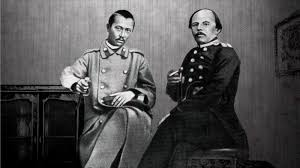
Shokan was famously “besties” with Dostoevsky sparking rumors about their homoertoic relationships.

Shokan Valikhanov the father of modern Kazakh history and ethnography and simultaneously the most-known Kazakh scholar, ethnographer, historian. As a Russian Imperial officer, he explored Central Asia, mapping regions like Kashgar and recording significant cultural, geographic, and historical data while advocating for his people which didn’t save him from being a target of post-colonial criticism. Lang Labbies are starting our weekly rubric of “not-so-Russian-Russian literature” focusing on literature written in Russian by not necessarily Russian personas.

Shokan Valikhanov was born in Kostanay, Eastern Kazakhstan and spent his youth in his father’s traditional nomadic yurt. Shokan’s family was very respected by the government of the Russian Empire, and Walikhanov’s father was awarded, during his life, six appointments as senior Sultan of Kushmurun region. Born into privelege, Shokan raveled extensively in Central Asia in the late 1850s after having graduated from the military academy in Omsk.

Walikhanov collected materials on Kazakh judicial practices in 1863. This was part of a government-backed project given by Duhamel, and led to the 1864 Memorandum on Judicial Reform. In 1864, Shoqan was assigned to help with Colonel Cherniaev’s continued conquest of Central Asia. Cherniaev’s forces marched west from the fortress of Vernoe (modern-day Almaty). Chernaiev advanced towards the Khanate of Kokand, planning to attack the fort at Aulie-Ata (modern-day Taraz). Shoqan unsuccessfully pushed for a negotiated result without violence. 

Young Valikhanov was a big proponent of Westernization although was critiqued by his fellow ethnographers for “playing the double game” due to his primarily russian education and deep friendship with writers such as Fyedor Dostoevsky.

In spite of it, Shokan remained the face of Kazakh intelligentsia — his early death at just 29 years old left a large hole in the history of Kazakh ethnography written in Russian. One of Shokan works (in both Russian and English) I would recommend to our readers is “Chinese Turkestan and Dzungaria: Walikhanov and other Russian travellers”, The Russians in Central Asia, London, Edward Stanford, 1865.

✈️ These plane tickets are getting expensive…

Learn your geography!!

If you’re just like me and shocked by these prices but still want to travel Language Lab might have something that you were looking for!

Take a trip around the world at the Language Lab’s World Trivia Night! We’re learning about cultures and languages around the world to get everyone in the study abroad spirit! Come ready to answer some tricky questions and compete to win prizes! Win or lose, pizza will be provided!

Most importantly, we will be hanging out Study abroad informational materials provided exclusively for us by the Study Abroad workers!

When? Thursday, March 12th @ 6PM

📍 Where? Vollum Lounge (2nd floor, turn right once you enter the building)

Spilling Linguistic TEA

I can actually tell how your country accessed tea leaves just by the way you say it. It’s not a magic trick or an elaborate mental gymnastics. The history of tea is broad, deep and a topic of heated debates. Ranging in various flavors from white herbal to decaffeinated earl gray, tea became a stable aspect in cultures across the world. And for such a widespread word and cultural phenomena one would expect that each language would develop a unique term to describe this healing liquid, right?

Not quite. Etymology of tea extends to just 2 derivatives: “tea-derived” and “cha-derived”. This etymology doesn’t depend on what linguistically family you speak — both Russian and Kazakh use the “chai” variation despite belonging to a Slavic and Turkic groups respectively. Similarly, both Armenian and Sudanese share a common “tea-“ derivation even though Armenian belongs to a unique branch of Indo-European family while Sundanese is an Austronesian language — thousands of miles apart.

The secret lies in the means of transportation, and more specifically, the space by which tea has conquered the world.

The term cha (茶) is “Sinitic,” meaning it is common to many varieties of Chinese. But most importantly, its roots are in the non-coastal Eastern part of China and spread the world through the ocean: first reaching Central Asia until it reached Persia and Eastern Europe.

Meanwhile, the “te” form used in coastal-Chinese (still East!) languages spread to Europe via the Dutch, who became the primary traders of tea between Europe and Asia in the 17th century. The Dutch ports mainly resided in Fujian and Taiwan where the local population used the “te” variations allowing this specific form to be spread via ocean.

To put it simply, if you say “chai” then you got your drink through land trade, and if you say “chai” you can thank the ports and ocean.

Of course, there is always room for a few exceptions. For instance, Polish uses the word “herbata” whose phonetics closely resemble that of English “herbs”. Thai language also stands out — instead of the internationally acclaimed “tea” or “chai”, Thai speakers use the term “miang” translated as “fermented tea leaves”.

Makes you think twice about ordering “chai tea” next time!

Who said “Karaoke”?

The Language Lab invites you to our annual highly-anticipated KARAOKE NIGHT! We’ll be singing songs in all languages and dancing the night away! You bring your voice and we’ll bring the snacks, disco lights, and snazzy multilingual vibes. We hope to sing with you there!

Bring your friends and let them sing their frustrations out!

What’s in the Language?

There’s a prevailing idea that Languages — unlike Chemistry, Economics or Anthropology — can be self-taught without having to sign up for classes or immersion programs.

To what extent is it true? While self-teach apps like Duolingo made a lingua-revolution in the language learning sphere, taking a class specifically dedicated to acquiring a new language has its hidden perks that not many know of.

Continue reading “What’s in the Language?”