William Trufant Foster, the first President of Reed College, was a strong
supporter of reforming the spelling of the English language. In 1909, while a
professor at Bowdoin College, Maine, he was on the Advisory Council of the
Simplified Spelling Board as well as being the Chairman of the Executive
Committee of the Maine Center of the Simplified Spelling Board. When he was
appointed President of Reed in 1910, he brought his convictions about spelling
with him.
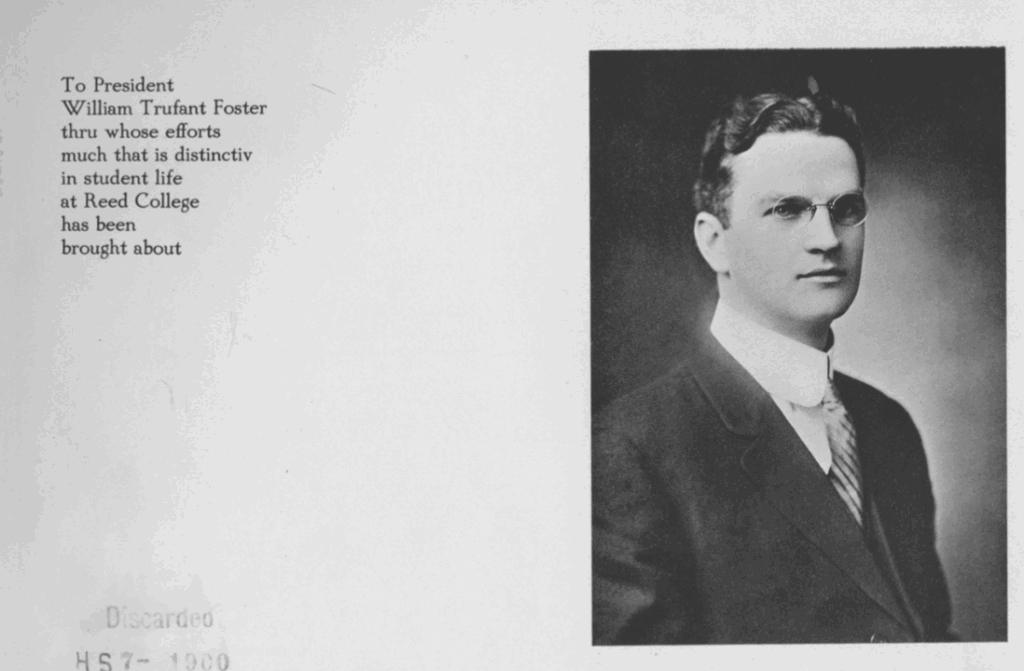
Due to Foster’s influence, simplified spelling was used in many of the college
publications. Perhaps the most notable was Reed’s first yearbook from 1915.
The students of the initial graduating class compiled it and included an
explanatory note on the verso of the title page that read:
Note—The simpler, briefer and more fonetic forms of English spelling recommended in the first four lists of the Simplified Spelling Board ar used thruout this volume
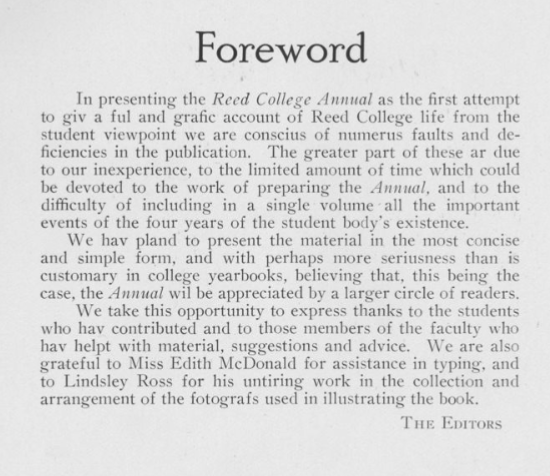
This publication confused readers then and continue to do so today; some think
that these early students were woefully bad spellers. What follows is a sample
paragraph from that first yearbook:
Other publications that reflect Foster’s simplified spelling influence for the
period of 1911 through 1919 are the student newspaper—the Quest, the 1916
Yearbook, and many official college documents. Number 1 of the Reed College
Record for March, 1911, notes that it “…starts out with simplified spellings—tho,
altho, thoro, thoroly, catalog, program, addrest, publisht, thru, thruout” (from
Simplified Spelling Bulletin, Vol. II:4, March 1911). It is interesting to note that
several of these words have become commonly accepted today.
Besides influencing the college publications, President Foster wrote articles and
gave talks in support of the new system. For instance, he addressed the annual
meeting of the Inland Empire Teachers Association in Spokane, Washington, in
April 1913, with a talk entitled “The Economics of Spelling Reform.” At least one Reed faculty member, Professor George H. Danton of German in 1915/1916, also
supported the new spelling, and in fact served on the Advisory Council of the
Simplified Spelling Board in 1913.
The Simplified Spelling Board was created in 1906 by Andrew Carnegie, who
supported it for twelve years. In an article in The New York Times, he stated that
he believed “English might be made the world language of the future” and thus
encourage universal peace. However, its role was hindered by its “contradictory
and difficult spelling” (NYT, 3/12/06). Many people adopted this idea besides Foster, including Mark Twain and William Dean Howells. In 1916, the Simplified Spelling Board restated its mission in the following manner:
The purpose of the movement is to hasten the process of rational orthographic change, to guide it in the direction of simplicity and economy; and gradually to substitute for our present caotic (sic) spelling, which is neither consistent nor etymologic, a simpler and
more regular spelling, based on existing rules and analogies, and in harmony with the history and genius of the language.
By 1918, Carnegie gave up on the idea, since even the Carnegie Institution of
Washington, D.C., did not use it in their reports. He wrote to the Board saying “I
think I hav been patient long enuf…I have a much better use for Twenty-five
thousand dollars a year.”
Original article by Mark Kuestner and Gay Walker, May 2009, additions by Tess Buchannan in 2026