
Do you find learning a language to be embarrassing? It’s a very normal human emotion, but embarrassment seems to be worse than death for some. Just thinking about embarrassment makes me feel embarrassed! So why do we feel embarrassed when we learn languages, and what can be done about it?
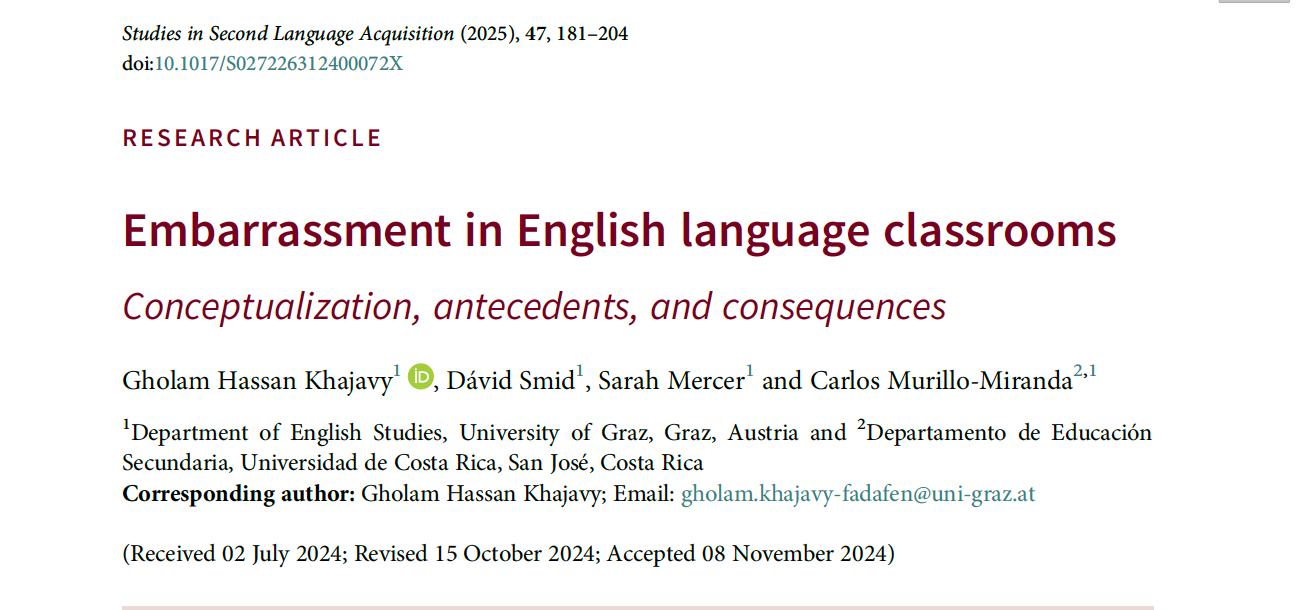
I read a paper titled “Embarrassment in English language classrooms” by Khajavy et al. (2025) to learn more about what embarrassment is and why it stops me in my tracks during my language classes. Embarrassment is defined as “a social, self-conscious emotion in which a person feels some level of discomfort and awkwardness” (Khajavy et al. 2025:182). I hate to say it, but embarrassment is just all in our heads. It can feel difficult to even explain why we feel embarrassed since it’s entirely based on how we imagine what others are thinking. Overall, it’s an emotion that depends on how we assess situations that we’re experiencing in the moment, so it might vary from person to person. For me, I get super embarrassed when I’m unprepared for class, but others might not feel the same way. This isn’t to say that feeling embarrassment isn’t valid—we all experience it, whether it’s visible or not.
Embarrassment is different from anxiety, since they happen at different points in time. Anxiety is a feeling of apprehension before a situation because it’s impossible to know what will happen when it happens. Raising my hand in class can be anxiety-inducing because I don’t know how others will react to what I will say. By contrast, embarrassment is a feeling that is experienced during a situation or afterward when we process it.
The researchers found that language students experienced embarrassment in four categories: Situation, Social Comparison, Interpersonal Behavior, and Competence. Let me explain below!
- Situation: certain activities triggered embarrassment, for example, giving a PowerPoint in front of the class.
- Social Comparison: when peers or teachers have higher language proficiency than us (real or perceived), students tend to be less inclined to continue participating.
- Interpersonal Behavior: receiving negative feedback from others resulted in increased feelings of embarrassment. One student reported that a peer told the teacher that “‘[their] English was too bad for communication’” (Khajavy 2025:189).
- Competence: when students self-assessed their language skills as being inadequate, they didn’t feel confident enough to use it. “‘I feel that by now I should have reached a professional standard of English’” (Khajavy 2025:189).
The bottom line of the study is that teachers and peers have a responsibility to create psychological safety in the classroom. Students should be allowed and encouraged to make mistakes and take risks in the classroom without being afraid that they will be treated negatively by their teachers and peers. Here at Reed, we owe that to each other! Making our classrooms psychologically safe for others then makes it psychologically safe for ourselves.
Lastly, the researchers mention that there is potential for embarrassment to be beneficial in the classroom. We often feel embarrassment in negative situations (“They’re judging me!”), but never in a positive context. This could look like taking risks to try something new and having confidence in our everyday actions. Embarrassment is, of course, a natural human emotion—it makes sense why we value others’ opinions so much! But it’s just as important to understand that embarrassment doesn’t need to control our lives. When learning a language, it’s inevitable that we will pronounce something wrong, use the wrong word, or misunderstand what someone else is saying. But who cares! That’s part of learning, and can only lead to more understanding between ourselves and others. Feeling embarrassment means that we’re concerned for others’ feelings and that we’re doing something outside our comfort zone. The point isn’t to be immune from embarrassment. But we should be proud of ourselves when we feel it, and maybe seek out situations that intentionally embarrass us. You never know where it could take you!
Khajavy, Gholam Hassan et al. “Embarrassment in English Language Classrooms: Conceptualization, Antecedents, and Consequences.” Studies in Second Language Acquisition 47.1 (2025): 181–204. Web.