What’s New On the Shelf?

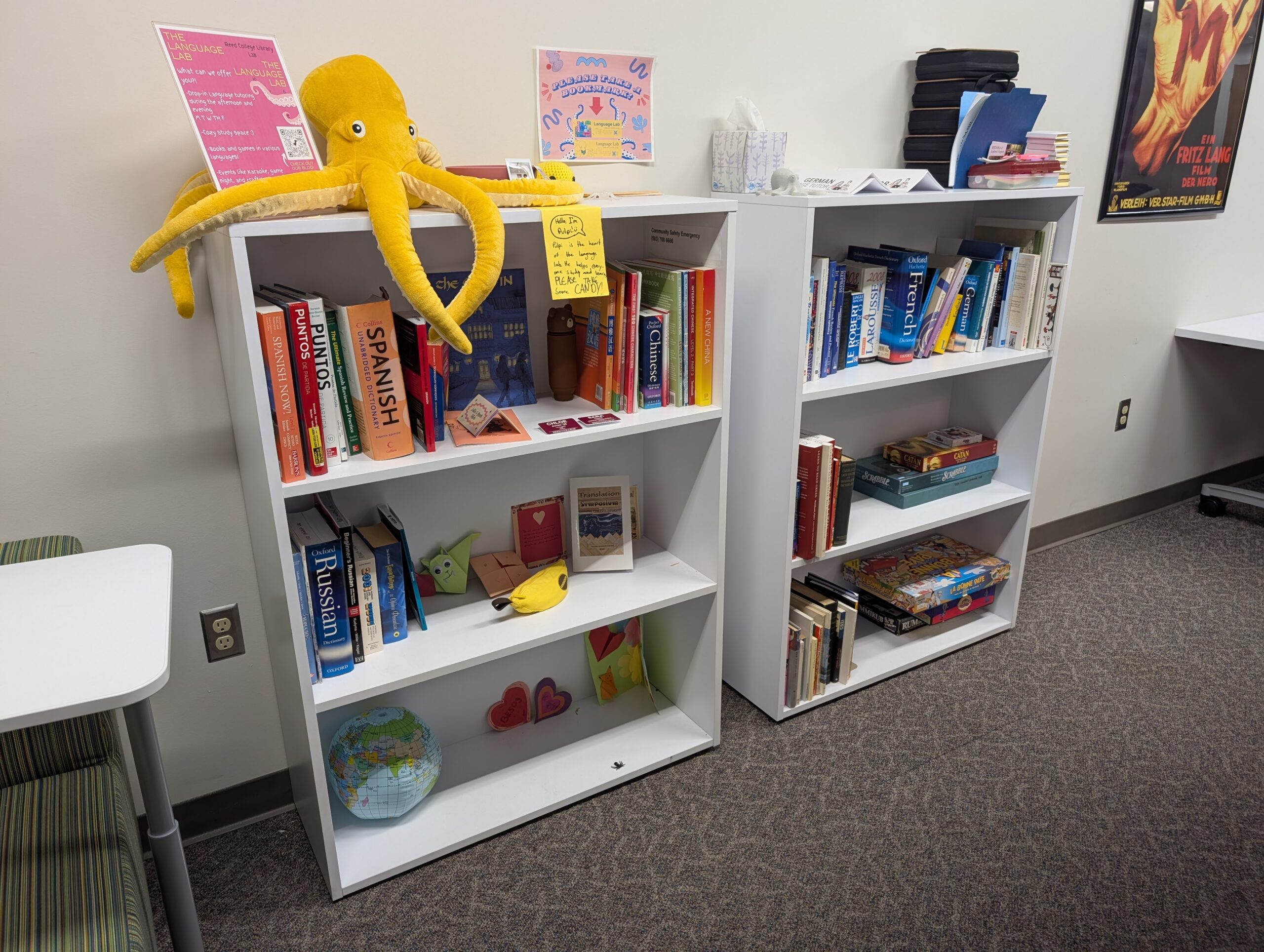
Pulpi the octopus invites you to have some candy and a bookmark!

I thought I’d give a shoutout to that unsung hero of local language resources, the LangLibrary – a title that I just invented to describe our humble but mighty pair of bookshelves in the Language Lab.

In addition to having a good number of printed copies of the required textbooks for language classes at Reed, the LangLibrary has a wide variety of literature for entertainment and information. From fables in traditional Chinese script to a magazine on (among other things) the Trans-Siberian railroad to a Nepali phrase book, the LangLibrary offers literature in many languages. I would say, though, that I’m most impressed with how many resources there are for learners of language classes taught at Reed. There’s textbooks, dictionaries, grammar books, script practice, and a book of idioms in Russian and English.

I’d like to give a particular shout-out to some of our newest additions as well as some items I found interesting. Yours truly brought in three Arabic storybooks for children and an Arabic script practice book that you can use dry-erase marker on, allowing you to easily and repeatedly scribble your way from alif to yaa’, as well as By Roman Hands: Inscriptions and Graffiti for Students of Latin, which I understand is in some demand in the beginner Latin classes (discipulae et discipuli, this is your hint to swing by the Lab!), and A New China for the intermediate Chinese students out there. I should mention that students in the past who felt moved to donate to the LangLibrary have just left their books on our figurative doorstep, hence how these books (and many others on our shelves) came here.

Moving away from the classroom towards beach reads (or perhaps armchair reads at this time of the year), I quite enjoy the look of Leben im Mittelalter. I might not know German, but I can identify a book on the Middle Ages when I see one. I also appreciate the Chinese translation of Der Steppenwolfe; it’s nice to see a translated work that wasn’t originally in English with a target language other than English.

Overall, I love the LangLibrary, and I hope to see it expand. Having studied Arabic at Reed, I’m biased when I say that I hope to see more comprehensive Arabic texts, whether for class or personal use. But I also hope to see a wider variety of casual literature at multiple levels of language learning across the board; from experience, I know that it can be hard to find literature that’s at your level of proficiency and that interests you personally. But who knows? Perhaps your next favorite is waiting for you in the LangLibrary…
Learning Latin with Jesse!

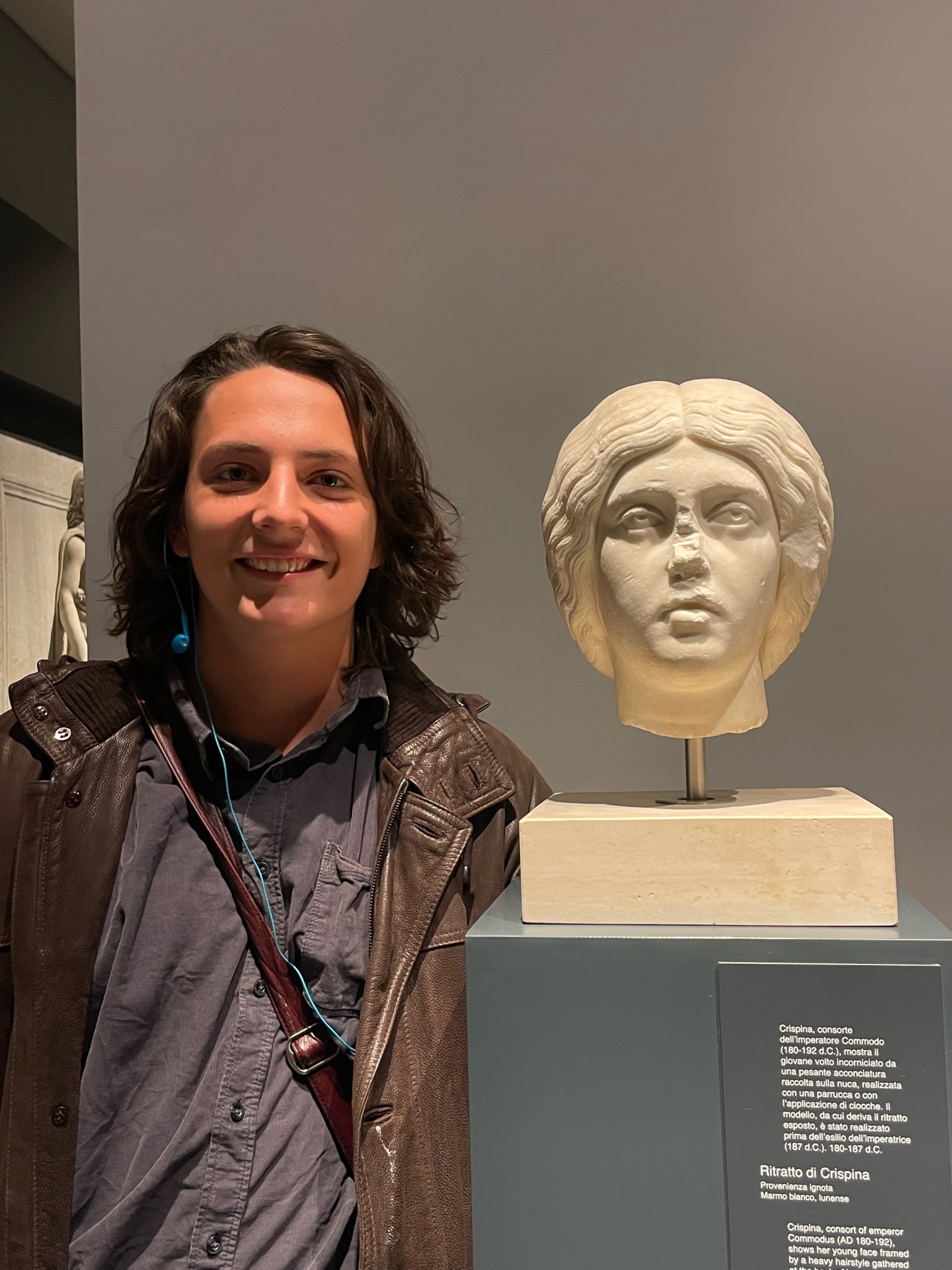
Today we’re chatting with Jesse, resident Latin tutor extraordinaire! From graffiti and translation to declensions and puns, Jesse describes the Latin tutor life at Reed. 

H: Could you say a few things about yourself (major, interests, etc.) and how long you’ve been studying your language? 

J: I am a Comp Lit major, and a Latin minor. I have been taking Latin since I started at Reed, and I love learning other languages. It’s so enjoyable to learn how a language works. I guess I should mention I’m from Philadelphia. I took French in high school, which is actually part of the reason I ended up taking Latin here; I’d never taken Latin before Reed, it wasn’t offered at my high school. My OWL recommended it to me as the intersection between history, English, and literature.

H: You said you enjoy learning other languages; are there any in particular you have in mind? 

J: I’ve studied Italian, which I will be forever mournful is not taught at Reed. 

H: How did you start to learn your language? 

J: First semester Latin at Reed was very technical,  and very different from learning any other language. I had never learned a language with declensions or Subject – Object – Verb order before, and I really began to enjoy it. It was a little bit of a puzzle. 

H: What resources would you recommend to students? 

J: I have two sets of recommendations: 1) Reed is a lot of grammar and fast — I would say use Anki for digital flashcards,  and Logeion, which is an online compilation of 7 Latin dictionaries.  2) Reading adapted Latin texts at an appropriate level. I understand why there’s not as much of that when taking Latin as compared to other language courses here; that’s the difference between teaching ancient & modern at Reed. But I would say it’s very beneficial.  

H: Do you have a favourite work in your language? 

J: I was actually dreading this question. For my all-time favorite, I would say Ovid’s Metamorphoses —  it’s confusing, it’s violent, it’s hard to make good sense of, it’s very difficult all around. Maybe that’s why I like it so much. But I suppose the work that I enjoyed the most was Catullus 63; it’s a tender poem, and different from a lot of his other works. 

H: What’s something you find interesting about your language? It could be a favorite word, grammar concept, or anything else.

J: I found Latin graffiti in Pompeii very interesting, and they teach some of it in Latin 101. Looking at the graffiti for the first time is like going from reading only Shakespeare to jumping on Twitter — you can actually see Latin as emerging from individuals, and not as just a dead construct or a set of rules. As for a favorite word, I guess I’ll say quaecumque; it means whichever, but it sounds ridiculous, and I guess that’s enough for me.

(Many good Latin jokes were exchanged)

H: What has your experience been like as a tutor? 

J: It’s really nice, actually. I’ve really enjoyed helping students. I’m also  the department assistant, so I get to feel nostalgia for being in the classroom again. When I took Latin 111, I really thought I would be trapped in the forest of the Latin textbook forever—no light, no way out, about to die—but now I’m out, so I can look back on it fondly.

H: What current class are you enjoying the most? 

J: Right now, I would say Russian 370, Literary Translation with Ivan Sokolov  — it’s an amazing class. The works that we study are just fascinating. We’re looking at a lot of interesting theorists and works, and we get to work on our own projects. 

H: That sounds wonderful. I just wanted to mention that you’ve been very helpful for me as well as other students in finding Latin resources, and I’ve really enjoyed talking to you.

If you would like to talk to Jesse in person, swing by the Language Lab any old Wednesday from 6-8 pm when he’s tutoring Latin.

Daniel Hahn’s “If This Be Magic: The Unlikely Art of Shakespeare in Translation” and My Profit On’t

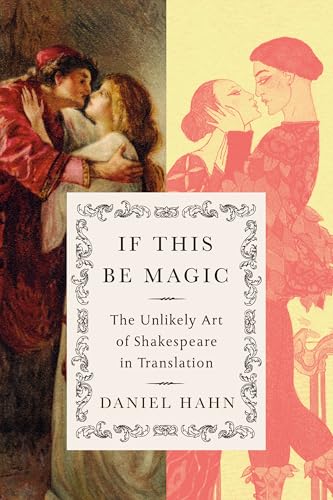
My personal favorite jacket for the book; would you say these people are about to “kiss by th’book”?

Surprising as it may sound for someone who is in the ongoing process of learning 4 different languages (yes, I’m counting my native English) and “plays o’ th’ viol-de-gamboys” (that’s Twelfth Night for you), I’ve always been daunted by the prospect of learning individual characteristics of a language that I’m not currently studying. I’ve had to memorize the trees before I can even start looking at the forest. So when I saw the latest addition to my local library’s catalogue, Daniel Hahn’s If This Be Magic: The Unlikely Art of Shakespeare in Translation, I was intrigued and yet daunted. We’re old buds, the Bard and I, and I wanted to hear him speak in other tongues; but how was I supposed to appreciate the travails of translating Shakespeare into Turkish? One curious look later, and I was standing next to the bookstand reading about how to treat Mark Antony’s prophecy that the spirit of Caesar will “cry havoc and let slip the dogs of war” (Julius Caesar 3.1. 280), when the nearest equivalent to the exclamation “havoc” in Portuguese is devastaçao, a word with an inconveniently large syllable count for a twelve-syllable sentence.

As a native Portuguese speaker and professional translator, Hahn may appreciate Antony’s use of matança in that particular translation, but he doesn’t know most of the featured languages, so he has to rely mostly on his colleagues from around the world and linguistic detective work such as noticing visual and vocal patterns in the translated text to understand and enjoy the translations. Since Hahn isn’t telling one story, each chapter is relatively stand-alone, only connected by how they bring up some of the literary, linguistic, and social components that make Shakespeare, well, Shakespeare. Each section has a certain topic, such as verse, alliteration, metaphor, rhyme, or humor, and each topic is allocated several examples from distinct languages. Hahn shares corresponding anecdotes, translation histories, and personal opinions on relevant topics in his field such as ‘fidelity’, ‘“literal” translation’, and of course, what kind of process translation really is.

In particular, I feel like his analogy of translation (itself a borrowed analogy), as a body that renews millions of cells over so and so many years’ time while remaining the same creature, is one that cuts to the quick of debates over the goal of translating creative literature. An instruction manual may be appropriately reduced to simply informing about a subject, but a play may involve poetry or prose, comedy or tragedy, songs and music, and a bevy of spoken and embodied devices that may shun even giving information at all for the sake of an effect. Honoring the writer/playwright involves recognizing what choices were made to achieve that effect and recreating them in the target language. And sometimes, in the case of works in Early Modern English, the target language is Modern English!

But I can’t cover all of the points Hahn makes, so I highly recommend you read his book and learn a little more about translation, especially if you enjoy Shakespeare’s plays or sonnets. Even if you find the Bard hard to understand or enjoy, I would still say check it out. Hahn’s writing is really approachable, and he doesn’t usually expect the reader to know the entire scene, play, or stanza that he covers, just as he doesn’t expect you to recognize all of the languages at play. Whether you go through the whole book front to cover or flip to a random chapter like I did, I’m sure you can delight in multicultural, multilingual Shakespeare.

Let’s Get Spooky!

Remember: Feed the lantern!

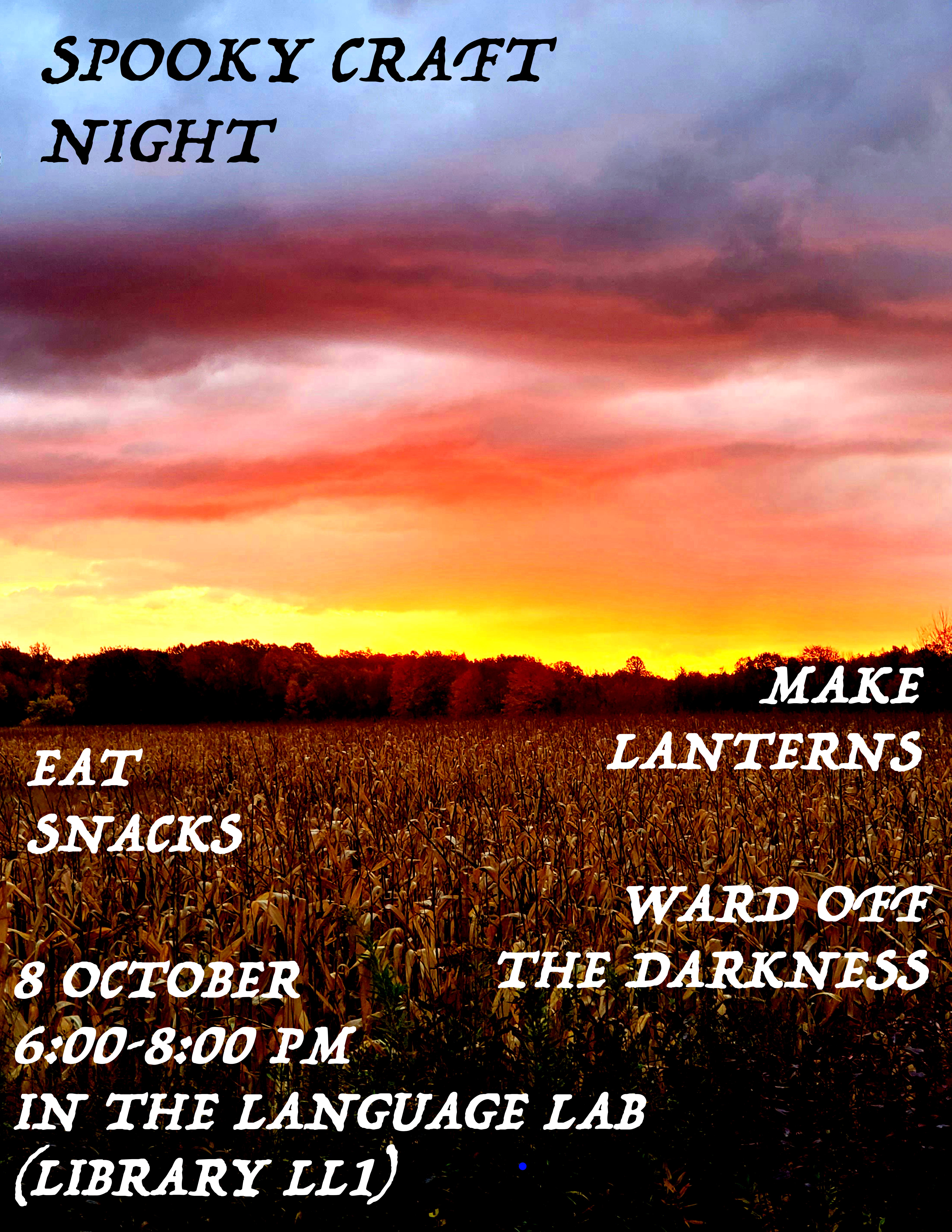
Are you terrified of the encroaching darkness? Or perhaps you find Fall Break a week too long to wait for fun?

Then come on down to the Language Lab for our Spooky Craft Night!
Join your fellow peers and LangLabbies in making paper lanterns (supplies provided) to decorate your room and maybe learn a little about other spooky traditions around the world. And of course, help yourself to some cozy snacks!

When? October 8, 6:00-8:00 pm
Where? Language Lab, Library LL1

Media Resource Recommendation

Long ago in my salad days at high school, I remember using tv5monde for outside practice after I had watched all the French films my library had to offer (alas, not that many). Although you now need a subscription to tv5monde to watch shows, tv5monde edu and tv5monde info remain wholly accessible online for free; no subscription needed to engage your French. Additionally, its lessons are separated into several levels ranging from beginner (débutant) to advanced (avancé), so you can find exercises suited to you. And not all of the activities are multiple-choice blank fill-ins; little puzzles are thrown in to mix it up! My favorite part about the network is that it maintains an international focus, covering events around the world, especially, of course, francophone countries.

Whether you’re looking for news or try finding a new edutainment medium, check out the website!