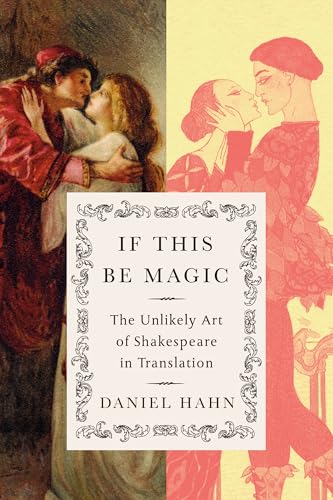
Surprising as it may sound for someone who is in the ongoing process of learning 4 different languages (yes, I’m counting my native English) and “plays o’ th’ viol-de-gamboys” (that’s Twelfth Night for you), I’ve always been daunted by the prospect of learning individual characteristics of a language that I’m not currently studying. I’ve had to memorize the trees before I can even start looking at the forest. So when I saw the latest addition to my local library’s catalogue, Daniel Hahn’s If This Be Magic: The Unlikely Art of Shakespeare in Translation, I was intrigued and yet daunted. We’re old buds, the Bard and I, and I wanted to hear him speak in other tongues; but how was I supposed to appreciate the travails of translating Shakespeare into Turkish? One curious look later, and I was standing next to the bookstand reading about how to treat Mark Antony’s prophecy that the spirit of Caesar will “cry havoc and let slip the dogs of war” (Julius Caesar 3.1. 280), when the nearest equivalent to the exclamation “havoc” in Portuguese is devastaçao, a word with an inconveniently large syllable count for a twelve-syllable sentence.
As a native Portuguese speaker and professional translator, Hahn may appreciate Antony’s use of matança in that particular translation, but he doesn’t know most of the featured languages, so he has to rely mostly on his colleagues from around the world and linguistic detective work such as noticing visual and vocal patterns in the translated text to understand and enjoy the translations. Since Hahn isn’t telling one story, each chapter is relatively stand-alone, only connected by how they bring up some of the literary, linguistic, and social components that make Shakespeare, well, Shakespeare. Each section has a certain topic, such as verse, alliteration, metaphor, rhyme, or humor, and each topic is allocated several examples from distinct languages. Hahn shares corresponding anecdotes, translation histories, and personal opinions on relevant topics in his field such as ‘fidelity’, ‘“literal” translation’, and of course, what kind of process translation really is.
In particular, I feel like his analogy of translation (itself a borrowed analogy), as a body that renews millions of cells over so and so many years’ time while remaining the same creature, is one that cuts to the quick of debates over the goal of translating creative literature. An instruction manual may be appropriately reduced to simply informing about a subject, but a play may involve poetry or prose, comedy or tragedy, songs and music, and a bevy of spoken and embodied devices that may shun even giving information at all for the sake of an effect. Honoring the writer/playwright involves recognizing what choices were made to achieve that effect and recreating them in the target language. And sometimes, in the case of works in Early Modern English, the target language is Modern English!
But I can’t cover all of the points Hahn makes, so I highly recommend you read his book and learn a little more about translation, especially if you enjoy Shakespeare’s plays or sonnets. Even if you find the Bard hard to understand or enjoy, I would still say check it out. Hahn’s writing is really approachable, and he doesn’t usually expect the reader to know the entire scene, play, or stanza that he covers, just as he doesn’t expect you to recognize all of the languages at play. Whether you go through the whole book front to cover or flip to a random chapter like I did, I’m sure you can delight in multicultural, multilingual Shakespeare.