Feminism in China: “Cell Block Tango” Reinterpreted

cw: violence, abuse, misogyny

“天朝渣男图鉴” or “The Scumbags of China” is a parodic rendition of “Cell Block Tango” posted on Weibo in November, 2018.

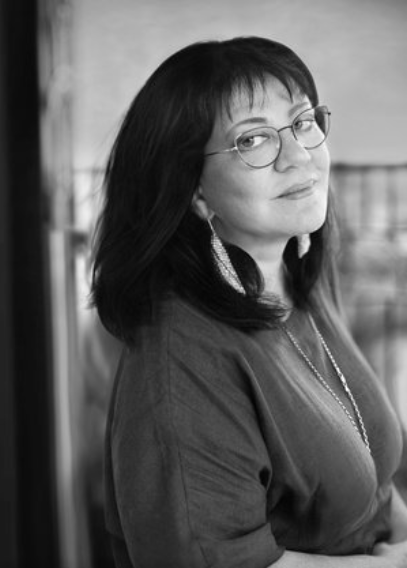
There is a good chance that you’ve heard of the infamous “Cell Block Tango” song from the 1975 musical Chicago. In the scene, six women in jail recount the vengeful murders they committed, describing their mistreatment at the hands of their former partners. Loosely translated as “The Scumbags of China,” “天朝渣男图鉴” is a parodic rendition of “Cell Block Tango” by Tú Yǒuqín (徒有琴), a student at the Central Conservatory of Music in Beijing. In the video Tú Yǒuqín plays six different women from six different cities in China, Beijing, Shanghai, Sichuan, Hunan, Guangdong, and Shandong. For each character, she slips into different dialects and recounts their acts of revenge against their abusive and misogynistic partners. While one woman recalls stumbling upon her husband’s notebook detailing his sexual exploits, another recalls being beaten by her husband.

“Cell Block Tango” from the 1975 musical Chicago

Posted on the Chinese social media platform, Weibo, in November 2018, the video roused conversation and debate about women’s rights and sexual and domestic abuse in China, contributing to a movement that has been gaining momentum in the past few years. The video was blocked and removed from the site not long after it was posted, speaking to how censorship has worked to silence and minimize the visibility of feminism in China. Nevertheless, the cultural and political impact of the music video cannot be undervalued.

I have been thinking about the significance of language, translation, and reinterpretation to the cultural and political impact of the music video. Representing six different regions of China, the six different dialects Tú Yǒuqín uses include Dongbei, Shanghai, Chonqing, Changsha, Shandong, and Cantonese. In re-appropriating an English song from an American musical, Tú Yǒuqín highlights the global phenomena of misogyny and barriers confronted by women everywhere. At the same time, her translation and reinterpretation of the song in multiple Chinese dialects serves to illuminate the distinctive lived experiences, oppression, and positioning of Chinese women in different regions of China. In this way, the “Chinese Cell Block Tango” is a testament and glimpse into the manifold languages of resistance and feminism across the world.

Full transcription and English translation for the song can be found here: https://supchina.com/2018/11/05/watch-tu-youqin-cell-block-tango-chinese-style/

Modern Russian Writers

We’re all familiar with, or at least have heard of, the classic novels of Dostoevsky and Tolstoy, but modern writers are sometimes left out when studying Russian. Here is a short introductory guide to some contemporary works you may want to check out!

Vera Polozkova is a Moscow-based poet, who often puts her poems to music. She started writing by posting poems on her blog, and was later discovered and published by the writer Alexander Zhitinsky. Her poems cover many facets of daily life, and are often characterized as nontraditional and without a particular form. She believes that performance is a crucial part of poetry, and you can find many of her videos on YouTube. Her collection of poems “Nepoemanie” is also available in Russian on Amazon.

Dividing her time between Moscow and Israel, Lyudmila Ulitskaya writes novels mostly pertaining to religious tolerance and inclusion. As an ethnically Jewish woman who is religiously Christian, her writing deals with these struggles and others during the Soviet Union. Her books, including her newest titled The Green Tent, can be purchased on Amazon. She is also a well-known activist, most recently appearing as a speaker in an anti-war protest in Moscow.

With her relatives including Leo Tolstoy and Ivan Turgenev, Tatyana Tolstaya was born into a family of writers. Her works mostly take place during, towards the end of, or as speculation after the Soviet Union, and her writing style is thought to be characteristic of Leo Tolstoy and Anton Chekhov. Several of her novels are available at the Reed library, including her most famous, The Slynx, a dystopian novel about a forgotten post-Soviet Moscow.

Media Recommendation: “Sommers Weltliteratur to go”

“Sommers Weltliteratur to go” (Sommer’s World Literature to go) is a German YouTube channel made by Michael Somme, and originally presented by Reclam (those little yellow books every German student knows and loves). Each episode summarises a literary work, from the German classics like Faust and Parzival to modern literature like Der Hobbit and Harry Potter.

The fun twist is that Sommer presents these works in vignette form, using Playmobil figures…

The episodes are fairly short, normally between 6 and 12 minutes, and are a great way to brush up on your knowledge of German literature (and other classics), while also practicing your listening skills.

The language in the episodes isn’t too complicated, but it is sometimes spoken a little fast. I’d recommend starting with some books you’re already familiar with. Start with something like Der Herr der Ringe (The Lord of the Rings) or Der große Gatsby (The Great Gatsby) before moving on to Goethe, Brecht, and Kafka!


Algarabía

Algarabía is a Mexico City-based magazine with a distinct quirky and ironic style. They publish pieces on science, language, history, art, and, according to their website, “little explored aspects of cotidianity.” Examples of their articles (which can be found on their website) include “Position Changes in Erotic Art”, “People don’t know how to drink coffee”, and “The Science on Cursing”.  Better suited for advanced Spanish learners, articles in this magazine are characterized by  playful yet accessible prose. Their series on etymologies is particularly good; sometimes poignant, often hilarious, always informative.

French graphic novels in the Reed College Library

Graphic novels are a huge form of popular media in France. Most French public libraries dedicate a large section to the bande dessinée alongside more typical forms of literature. French graphic novels have a flavor that is somehow both romantic and sordid, and a pace that runs much slower than a comparable American comic strip (the French are less concerned whether the story has a hero, follows an arc, or moves towards any resolution). They are typically very funny. Lucky for us, the Reed College library has several shelves of French bandes dessinées! For this blog, I read and reviewed four of them.

Most of the stories I read for this blog are in the realm of the fantastic, and I  recommend going through slowly to absorb both images and the text. Sit down with a notebook and a dictionary, and plenty of time to take in both art and storytelling. These books are accessible to intermediate or advanced readers.

Finally, these graphic novels are a great source of new vocabulary since they include plenty of colloquialisms. A set of flashcards on Quizlet is linked below with my favorite words and phrases from the bandes dessinées I read.

https://quizlet.com/237885378/french-phrases-of-interest-flash-cards/

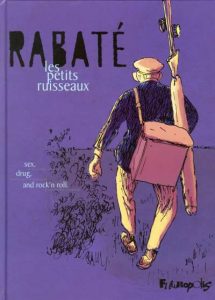
Les petits ruisseaux, Pascal Rabaté. 2006.
Call no. PN6747.R33 P48 2006

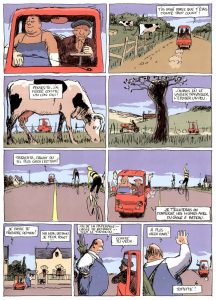
This story follows an old man named Emile who no longer finds much meaning in his old age. One day while out fishing, his best friend tells Emile to stop pitying himself and take full advantage of life while he can. Emile’s quiet life of solitude ends abruptly when he starts to take this advice. Do we assume that life and lust belong to the young? The tricks up his sleeve are predictable, but Emile’s character is compelling and it’s funny to see his sleazy side let loose. This bande dessinée won the Grand Prix de la Critique in 2007 from L’Association des Critiques et journalistes de Bande Dessinée (ACBD). It was made into a film in 2010.


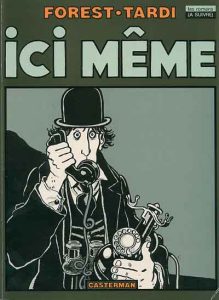
Ici Même, Jean-Claude Forest et Jacques Tardi. 1979.
Call no. PN6747.F687 I35 2006

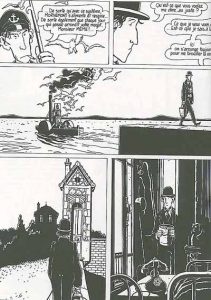
This is a strange fairy tale about a man who lives atop the walls surrounding a neighborhood. He is not allowed to descend or set foot on the land below. Arthur Même, as the man is called, walks a fine line between dignity and mania, satire and hyperbole, as he gatekeeps for the wealthy socialites beneath the walls. A boatman comes once a day to deliver mail, cheese and wine. These are Arthur’s only interactions. The plot is full of tropes (spies, an ancient inheritance, war between the families, and a love affair) but intriguing nonetheless for its oddity. The novel is in black and white.


Le Dérisoire, Olivier Supiot et Eric Omond. 2002.
Call no. PN6747.S85 D4 2002

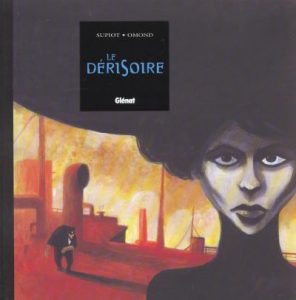
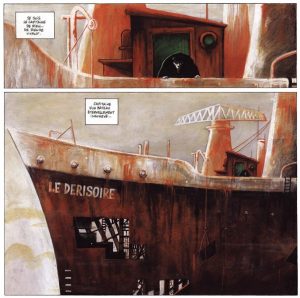
Le Dérisoire is a mix between Moby Dick and Alice in Wonderland. It features a solitary captain on a derelict ship in the ocean, going nowhere, in despair about his situation and his inability to fix it. His crew are all skeletons, having died some time ago, yet somehow remaining on board the ship. It seems that nothing ever leaves the ship and the ship itself never leaves. The furnace at the heart of the ship has gone out, leaving only cold empty steel, but still it floats. And which of the characters are living? Into this drifting tapestry comes a phantom woman, Constance, who brings color and life onto the ship. Is she real? Is the ship? Is anyone? The graphic novel has a dreamy watercolor-like style and is beautiful enough that it doesn’t matter that the plot doesn’t make sense.


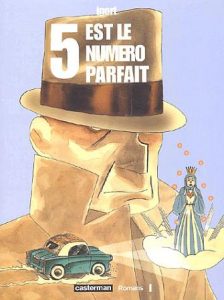
5 est le numéro parfait: 1994-2002, Igort, translated from Italian by Lidia Licari. 2002.
Call no. PN6767.I36 A6314 2002

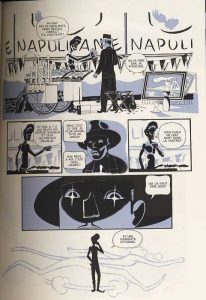
This graphic novel was originally a three-part series that was later collected into one large volume. It follows a family in Naples embroiled in classic 50s-era mob drama. Think The Godfather–there’s shootouts in the woods, religious symbology, intimate family scenes, rivalries and backstabbing. The book moves quickly, lots of people get shot, and there is only one woman, the damsel in distress. This is a true Italian action comic, with a minimalist art style in grayscale and simple block colors. The author, who writes under the name Igort, has been at the center of the Italian comic scene for decades and published many other graphic novels. 5 est le numéro parfait is his most famous.
       

Copyright: All images taken from www.bedetheque.com/

“Les petits ruisseaux,” Pascal Rabaté. Futuropolis. 2006. https://www.bdgest.com/chronique-1530-BD-Petits-ruisseaux-Les-petits-ruisseaux.html?_ga=2.50200686.916534693.1512955637-12593617.1508988380

“Ici Même,” Jean-Claude Forest et Jacques Tardi. Casterman. 1979. https://www.bedetheque.com/serie-1684-BD-Ici-Meme.html

“Le Dérisoire” Olivier Supiot. Glénat. 2002. https://www.bedetheque.com/serie-6173-BD-Derisoire.html

“5 est le numéro parfait,” Igort. Casterman. 2002. https://www.bedetheque.com/serie-5200-BD-5-est-le-numero-parfait.html
恨海 ‘The Sea of Regret’

This novel was written by Wú Jiǎnrén in 1906. In ten chapters, the reader follows the story of two couples and their families as they head to Shanghai to escape the turmoil during the Boxer Rebellion in 1900. This would be recommended for intermediate to advanced learners, but the translated version also provides insight into the discussion around family, marriage, and the status of women at the time.