
This past year, Chemistry instructor Patrick Poletti utilized the Dye Garden to make indigo dye for the first lab of the semester in CHEM 102 – Introductory Chemistry.
For quite a few years, CHEM 102 has done an indigo lab where they synthesize indigo from 2-nitrobenzaldehyde and acetone. Once they have synthesized the dye, they use it to dye a test fabric swatch.
Instructor Poletti said, “Typically, the synthesized stuff works really well on spun polyamide (Nylon 6.6) as well as spun diacetate. Conversely, it chews up the worsted wool beyond recognition. A random conversation in the locker room at the sports center (of all places), made me aware that there was a healthy supply of natural indigo on campus.” He contacted Nar Johnson-Harmansah ’27, a Sustainability Intern and Studio Art student worker, who supplied the class with more than enough dried indigo leaves for use, in addition to a nice procedure to extract the dye.
To introduce the natural dye, they broke each lab section in half, with half of the lab groups making the synthetic indigo dye and the other half of the lab groups extracting the natural dye from the leaves. Each lab group first dyed a swatch with the dye that they had prepared. They then added their dye to the synthetic pool or to the naturally obtained pool and finished by dyeing a swatch with the dye that they had not prepared. The analysis included a comparison of the two methods.
About their findings, Poletti said, “Generally, we saw that the natural dye didn’t dye the swatches as darkly as the synthetic dye, although that could have been because I was guestimating on the amount of the natural dye to use.” It also took longer for the indigo color to evolve from the natural dye. The trend with respect to the relative success of dyeing the six types of fabrics was roughly the same between the natural and synthetic dyes, although the natural dye was markedly better at dyeing the worsted wool (i.e., it didn’t chew it up beyond recognition).
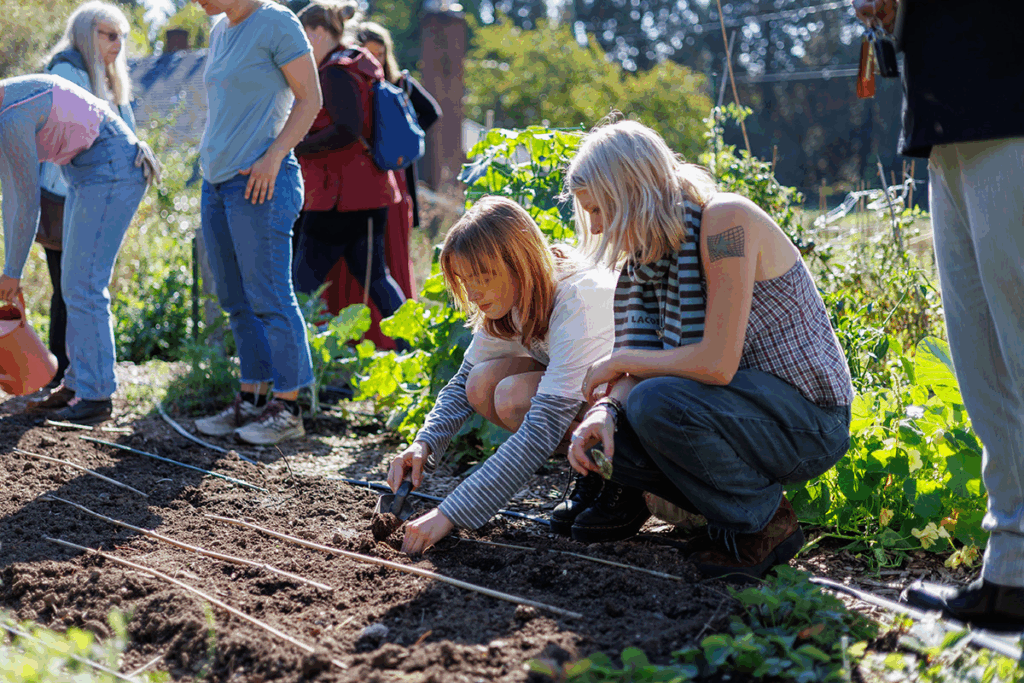
Experiments like these are a wonderful example of endless ways our community garden (located outside of the Garden House) can be utilized!
Read more about the Sustainability and Environmental Justice program at Reed through their website!
They host regular work parties, where students, staff, and alumni can lend a hand for whatever work is needed. In the past, this has been everything from harvesting pumpkins and squash, to adding compost to the garden beds, to installing a drip irrigation system.