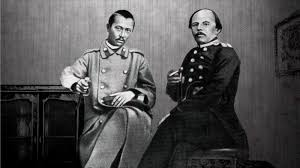
Shokan Valikhanov the father of modern Kazakh history and ethnography and simultaneously the most-known Kazakh scholar, ethnographer, historian. As a Russian Imperial officer, he explored Central Asia, mapping regions like Kashgar and recording significant cultural, geographic, and historical data while advocating for his people which didn’t save him from being a target of post-colonial criticism. Lang Labbies are starting our weekly rubric of “not-so-Russian-Russian literature” focusing on literature written in Russian by not necessarily Russian personas.
Shokan Valikhanov was born in Kostanay, Eastern Kazakhstan and spent his youth in his father’s traditional nomadic yurt. Shokan’s family was very respected by the government of the Russian Empire, and Walikhanov’s father was awarded, during his life, six appointments as senior Sultan of Kushmurun region. Born into privelege, Shokan raveled extensively in Central Asia in the late 1850s after having graduated from the military academy in Omsk.
Walikhanov collected materials on Kazakh judicial practices in 1863. This was part of a government-backed project given by Duhamel, and led to the 1864 Memorandum on Judicial Reform. In 1864, Shoqan was assigned to help with Colonel Cherniaev’s continued conquest of Central Asia. Cherniaev’s forces marched west from the fortress of Vernoe (modern-day Almaty). Chernaiev advanced towards the Khanate of Kokand, planning to attack the fort at Aulie-Ata (modern-day Taraz). Shoqan unsuccessfully pushed for a negotiated result without violence.
Young Valikhanov was a big proponent of Westernization although was critiqued by his fellow ethnographers for “playing the double game” due to his primarily russian education and deep friendship with writers such as Fyedor Dostoevsky.
In spite of it, Shokan remained the face of Kazakh intelligentsia — his early death at just 29 years old left a large hole in the history of Kazakh ethnography written in Russian. One of Shokan works (in both Russian and English) I would recommend to our readers is “Chinese Turkestan and Dzungaria: Walikhanov and other Russian travellers”, The Russians in Central Asia, London, Edward Stanford, 1865.