Read about my conversation with Mira, our German language tutor! Topics included media recommendations, tips on learning languages, and some of the language courses offered at Reed!
Mira has drop-in tutoring hours from 6-8 on Tuesdays.
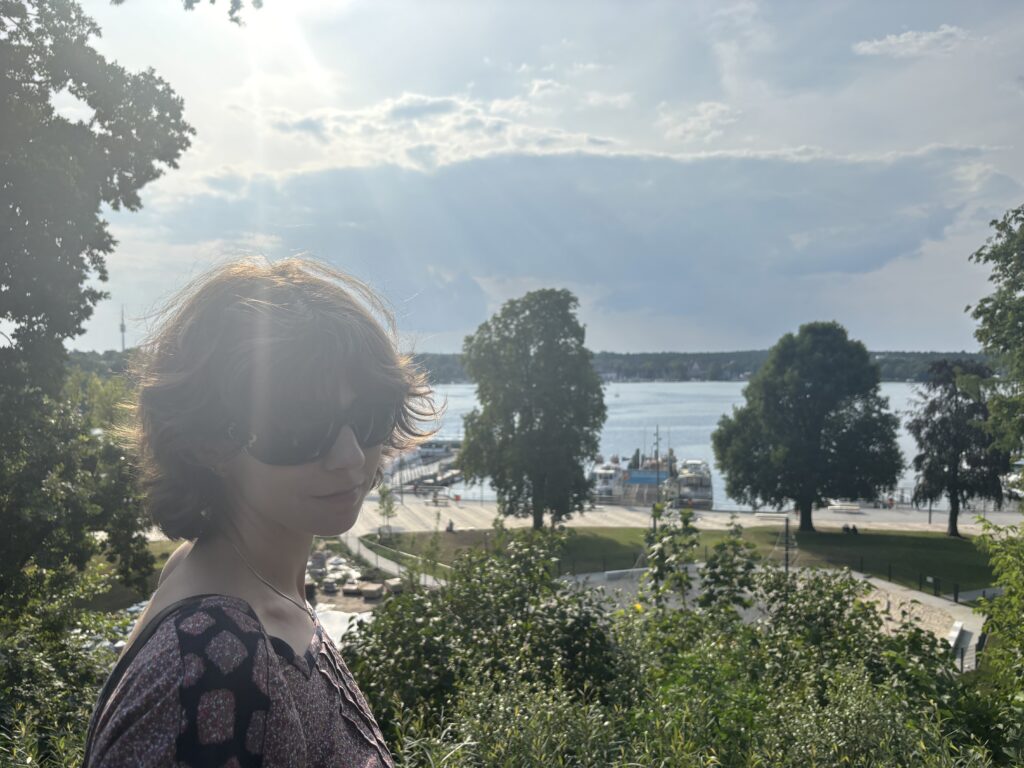
Mira: I’m Mira, a junior comparative literature major with a sociology focus, and I’m doing a German minor. I think that for my thesis, German literature will be a big part of it. I love the German department here and I’ve been speaking German for around 8 or 9 years.
Annie: Wow, 8 years? Where were you learning German?
M: I used the internet to learn it. [A: Cool.] Yeah, because my school didn’t offer German, I just started doing it myself with the internet, with YouTube videos in German, and just hearing it as much as I could. And it worked because, you know, I speak it now! Also, one of my dad’s colleagues is Swiss German, and so she tutored me a bit as well.
A: That’s really encouraging. I feel like I keep deciding to learn a new language, and so I’m just doing Duolingo and I spend 2 weeks on it, and then it falls off. But to know that you can keep going with it and it can actually bring something is really cool. So, your dad’s co-worker, is she what made you decide to start taking German or was it something else? Are there any other languages you know?
M: No, my dad’s family is German, so my grandpa—I think he spoke more German when he was growing up—he still spoke German when I was a kid, and I heard him speak it, and I always thought it was really cool. He was a cool guy. That made German seem like something cool in my mind and that’s what initially made me want to start learning German. And then once I started learning, I found my own interest within it that encouraged me to keep going with it.
A: You talked about your school not offering German as a language, and starting out teaching yourself and learning online. Could you talk more about that? And that experience of transitioning from this place of self-teaching, to a higher academic setting, where there’s all these classes and it’s pretty rigorous.
M: Yeah. I guess it was tough at first because when I would talk with my dad’s coworker and she helped me with some of the grammar stuff, I guess it was a weird feeling because I could speak the language, but then struggled a lot with the grammar part of things. So that was kind of challenging when I came to Reed and in my very first semester took a German class, but I feel like I learned enough technical grammar stuff from that class and before that it wasn’t too overwhelming, but it was an adjustment to get used to the technical grammar things as well, while already having intuitive senses for what is happening grammatically.
A: I feel that…the Dativ, Genetiv, all of that. You can’t win…So, is German the only language…?
M: I also speak French. But that’s a less impressive story because I just took it in high school.
A: Have you continued that here at Reed at all?
M: Yeah, I took a class with Catherine Witt, and it was really awesome. Post-war French Cinema was an awesome class.
A: Shout out! All right, what was your experience learning German? And is there anything that stands out to you as particularly difficult or easy? I know a lot of people talk about getting exposed to a language at a young age being very useful. I’ve taken German since kindergarten and was exposed to it because I also have family in Germany. I feel like that made my learning experience a lot easier. Do you notice anything like that, or are there any challenges you faced in the larger learning process?
M: Yeah, I guess having some exposure to it as a kid definitely made it easier because it wasn’t totally unfamiliar when I started. I think learning how to understand when it’s spoken or something is a lot easier than actually getting around to speaking. And I think it was hard at first to transition into speaking German with people. Even now, it can be intimidating to get started. But once you jump in and are willing to make mistakes, it gets a lot easier to just start speaking the language.
A: Yeah, for sure. It’s easy to learn a few phrases, but getting to that fluency is really challenging. Do you have any advice to help make that process easier?
M: My main advice is, and I feel like I’ve been repeating this a lot because my boyfriend’s actually learning Chinese and studying abroad in Shanghai…I’m always telling him “you need to do as much as you possibly can to hear it all the time, even if you can’t understand it.” Even if you’re trying to listen to a podcast or something that’s maybe too advanced, that still is helpful, absorbing as much of it as you can and not getting too caught up in individual details: oh, I don’t know this; how does the grammar work in this exact scenario? I feel like that’s not a big deal compared to just getting as much exposure as you can.
A: Totally. On that note of exposure to language, do you have any particular pieces of German media that you’d recommend to people?
M: That’s really tough because there’s a lot of things. For people who are just starting to learn, I would say the YouTube channel Easy German. It’s the most helpful thing ever, because it’s interviews with people speaking German about specific topics. So you learn specific vocab and that was the most helpful thing ever. And then for pieces of media…there’s this show (I feel like crime shows are really good in German as well) that I watched a lot when I was starting to learn German, and it’s called Babylon Berlin. It takes place in the 1920s and has that kind of vibe. They’re speaking the Berlin dialect, so I got some exposure to the Berlin dialect, which is pretty cool. It sounds really funny, but it was cool to get some of that.
A: For sure. Is there anything about Reed’s approach to language learning that stands out to you and do you have a favorite class you’ve taken in the language department?
M: Yeah! I like that it’s pretty immersive in the actual language classes. You start, from the beginning, actually speaking the language instead of having to do just grammar all the time with no actual exposure. And I also really love that in the literature language courses, there’s the speaking section, so you get to speak the language. I really enjoyed that. I took Mass Media with Jake Fraser, and that was an awesome class. That was one of my favorite classes that I’ve taken at Reed in general. We read an entire book in German, which was really, really awesome, and having the German speaking section was a really cool way to approach what we were learning in class.
A: Awesome. Shout out Jake, he’s awesome. [M: Yeah, it’s true.] Yeah. This is more just for fun, but do you have a favorite word or saying in German? And why?
M: That’s another tough one. I like the word Fernweh… [A: That’s my favorite word in German, too!] I feel like people always know Fernweh. I think it just describes something that…there’s another German word that people use for Fernweh. [A: Wanderlust?] Yeah, I guess most people mean the same sort of thing, but I think that Fernweh is just really specific. I love it.
A: Yeah, it’s such a poetic word and I feel like people don’t always talk about German being a very romantic or poetic language, but it really can be. It’s also very funny sometimes. German humor is just…it’s just so dry. And yet in the language, it’s really funny. Is there something else that you would want to say to students interested in language learning?
M: I would just say to not be intimidated by it. I feel like especially German gets a bad rap and people are like, oh German, so hard to learn, and the grammar is so hard to figure out, but I feel like it’s overhyped. It doesn’t have to be a scary thing. I think you can enjoy learning languages from the beginning. Even if you don’t like the grammar learning part, you can still learn a language without having to focus too much attention on that and it’ll come naturally and be easier. But yeah, I guess my advice would be just don’t be scared of getting started!