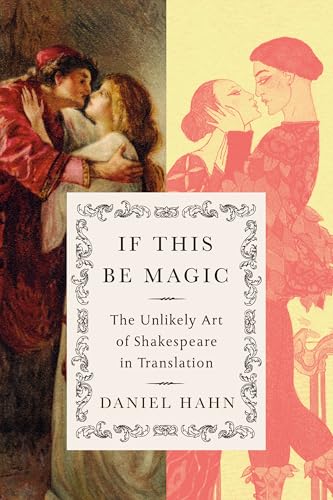
Daniel Hahn’s “If This Be Magic: The Unlikely Art of Shakespeare in Translation” and My Profit On’t

My personal favorite jacket for the book; would you say these people are about to “kiss by th’book”?

Surprising as it may sound for someone who is in the ongoing process of learning 4 different languages (yes, I’m counting my native English) and “plays o’ th’ viol-de-gamboys” (that’s Twelfth Night for you), I’ve always been daunted by the prospect of learning individual characteristics of a language that I’m not currently studying. I’ve had to memorize the trees before I can even start looking at the forest. So when I saw the latest addition to my local library’s catalogue, Daniel Hahn’s If This Be Magic: The Unlikely Art of Shakespeare in Translation, I was intrigued and yet daunted. We’re old buds, the Bard and I, and I wanted to hear him speak in other tongues; but how was I supposed to appreciate the travails of translating Shakespeare into Turkish? One curious look later, and I was standing next to the bookstand reading about how to treat Mark Antony’s prophecy that the spirit of Caesar will “cry havoc and let slip the dogs of war” (Julius Caesar 3.1. 280), when the nearest equivalent to the exclamation “havoc” in Portuguese is devastaçao, a word with an inconveniently large syllable count for a twelve-syllable sentence.

As a native Portuguese speaker and professional translator, Hahn may appreciate Antony’s use of matança in that particular translation, but he doesn’t know most of the featured languages, so he has to rely mostly on his colleagues from around the world and linguistic detective work such as noticing visual and vocal patterns in the translated text to understand and enjoy the translations. Since Hahn isn’t telling one story, each chapter is relatively stand-alone, only connected by how they bring up some of the literary, linguistic, and social components that make Shakespeare, well, Shakespeare. Each section has a certain topic, such as verse, alliteration, metaphor, rhyme, or humor, and each topic is allocated several examples from distinct languages. Hahn shares corresponding anecdotes, translation histories, and personal opinions on relevant topics in his field such as ‘fidelity’, ‘“literal” translation’, and of course, what kind of process translation really is.

In particular, I feel like his analogy of translation (itself a borrowed analogy), as a body that renews millions of cells over so and so many years’ time while remaining the same creature, is one that cuts to the quick of debates over the goal of translating creative literature. An instruction manual may be appropriately reduced to simply informing about a subject, but a play may involve poetry or prose, comedy or tragedy, songs and music, and a bevy of spoken and embodied devices that may shun even giving information at all for the sake of an effect. Honoring the writer/playwright involves recognizing what choices were made to achieve that effect and recreating them in the target language. And sometimes, in the case of works in Early Modern English, the target language is Modern English!

But I can’t cover all of the points Hahn makes, so I highly recommend you read his book and learn a little more about translation, especially if you enjoy Shakespeare’s plays or sonnets. Even if you find the Bard hard to understand or enjoy, I would still say check it out. Hahn’s writing is really approachable, and he doesn’t usually expect the reader to know the entire scene, play, or stanza that he covers, just as he doesn’t expect you to recognize all of the languages at play. Whether you go through the whole book front to cover or flip to a random chapter like I did, I’m sure you can delight in multicultural, multilingual Shakespeare.

Petit Poulet, Henry Hühnchen, Pollito Tito… also known as Chicken Little

Petit Poulet, aka Chicken Little, looking at his computer. “Le ciel est en train de tomber!”

THE SKY IS FALLING, and you can read that in three other languages on TheFableCottage.com. I discovered this website with a friend as we attempted to read bedtime stories in each other’s languages. TheFableCottage is a multilingual library of bedtime stories written in French, German, Spanish, and also Italian! Each story has a few features that make it really helpful for beginning students: audio recordings, captioned video animations, illustrations, and English translations if you get stuck. All of their free short stories can be found on each language’s respective website: TheFrenchExperiment.com, TheGermanProject.com, and TheSpanishExperiment.com. (Stories can also be accessed on TheFableCottage, but not all of them are free.) This is a great resource for beginner-level students, as the grammar and vocabulary are written using everyday and simple language. These stories expand upon the beginner-level language you’ve learned so far using a story you’re likely already familiar with. Having an additional resource like this can supplement what you learn in class and in your textbook by creating a new context where you use your target language. For example, you may have introduced a photo of your family to your 100-level class, but you can practice that same family vocabulary in the context of Goldilocks and the Three Bears. I found the short stories on TheFableCottage to be the perfect resource for anyone in their first year of a language class, and I recommend that you check it out!

Heal your inner child with Chinese kids’ cartoons!

Reading Sara’s post on Soviet Winnie the Pooh truly inspired me. As a beginning Chinese student, I love watching C-dramas, but sometimes it’s a bit challenging to understand what’s going on, especially with the complex love triangles! Children’s cartoons are a great way to introduce yourself to more Chinese media, especially because they’re designed to use elementary-friendly language. Even if they don’t have captions in English, the animation style can make it easy to pick up on the story and characters. Here are some recommendations I’ve found, plus a bonus C-drama recommendation!

喜羊羊与灰太狼 – Pleasant Goat and Big Big Wolf

Continue reading “Heal your inner child with Chinese kids’ cartoons!”

Non-trivial way to improve your Russian and make everybody believe you’re a native speaker (sort of….)

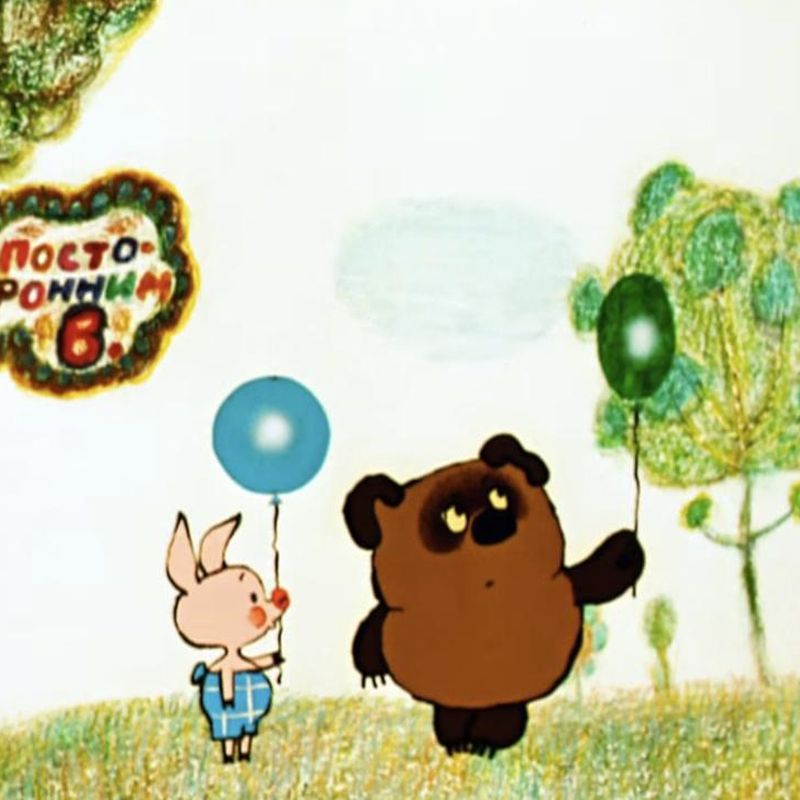
Soviet Winnie the Pooh is a core childhood memory of mine

It’s never been a secret — Russian is notoriously challenging, filled with confusing conjugations and challenging slang that leaves even the most experienced learners crying, screaming and pulling their hair.

But you don’t have to jump straight into banging your head with a thick Oxford dictionary — there are multiple easy – perhaps even childish – ways to upgrade your Russian skills.

Continue reading “Non-trivial way to improve your Russian and make everybody believe you’re a native speaker (sort of….)”

The Duolingo French Podcast: Découvrez l’histoire de Joséphine Baker

Are you looking for more ways to immerse yourself in French? Podcasts are a great way to implement French into your everyday life. It’s especially important to engage with the language outside the classroom. Whether you’re taking a walk around the canyon, getting lunch in Commons, or trying to fall asleep, a podcast can add a lot more French exposure to your life. It’s a simple way to improve your French comprehension, vocabulary, and cultural knowledge. At the same time, it can be difficult to find the right one. For beginning to intermediate students, I have a recommendation for you: The Duolingo French Podcast!

Continue reading “The Duolingo French Podcast: Découvrez l’histoire de Joséphine Baker”

Podcasts en Español

Learning a language can be exceptionally frustrating. Especially when the only times you are hearing this language is in a classroom, three times a week, for 50 minutes. You’ve probably heard your Spanish teacher tell you to listen to music and movies in Spanish since your first class in middle school. While this is good advice, it can be hard to understand music in Spanish such as Reggaeton, cumbia, or Spanish hip hop when you aren’t as familiar with the language. The words blend or maybe there is too much slang to comprehend whatever Bad Bunny or MC Solaar is saying. To that I say do not fret, podcasts are the way to go!

Continue reading “Podcasts en Español”

Beginner Arabic Youtube

Are you beginning to learn Arabic and in need of some fun and easy media to help boost your vocabulary? Look no further… !يالله

  1. All About Me

Tareq and Shireen are learning how to be kind and considerate friends! Tune in if you’re looking to fill your vocabulary with wholesome terms about friendship and sharing.

2. Arabic Fairytales

Arabic retellings of classic fairytales using simple language and helpful subtitles.

3. Totally Spies! Arabic

Subtitled episodes of Totally Spies! dubbed in Arabic! Ideal if you need something more sophisticated than fairytales.

4. Obayd Fox

Obayd Fox is a British Youtuber living in Saudi Arabia. As a fellow Arabic learner (albeit an advanced one), he tends to speak slightly more slowly than a native, and he usually uses الفصه 🙂

5. Learn Arabic with Khasu

Khasu is also an Arabic learner and a very talented teacher. His channel includes roleplays, skits, vocab lessons, and breakdowns of grammatical concepts.

Kali Uchis Could Help You Learn Spanish!

Kali Uchis is a Colombian-American singer and songwriter with four albums and various EPs and singles in her discography. Uchi’s two earliest albums, Por Vida and Isolation, are primarily in English but are heavily influenced by Latin R&B, soul, psychedelic soul, and Latin American Boleros. For anyone learning Spanish, these earlier albums might improve your cultural fluency with modern Latin music and musicians. Likewise, for someone at a 200-400 level in Spanish, Uchis’ two most recent albums Sin Miedo (del amor y otros demonios) and Red Moon in Venus, are a great way to immerse yourself in gooey eclectic bilingual love-stricken bops that tease with verses flowing between Spanish, English, and Spanglish. If you’re struggling to understand the fast-paced lyrics of musicians such as Bad Bunny or even Rosalia, Kali Uchis might be the girl for you. Her slow hooks and unique take on reggaeton make you want to play her discography on repeat. Rumor has it that Uchis will be releasing her fourth studio album very soon so get ahead of the trend while you’re at it! Feel free to check out her socials if you need some more convincing 😉
Gracias y buena suerte!